

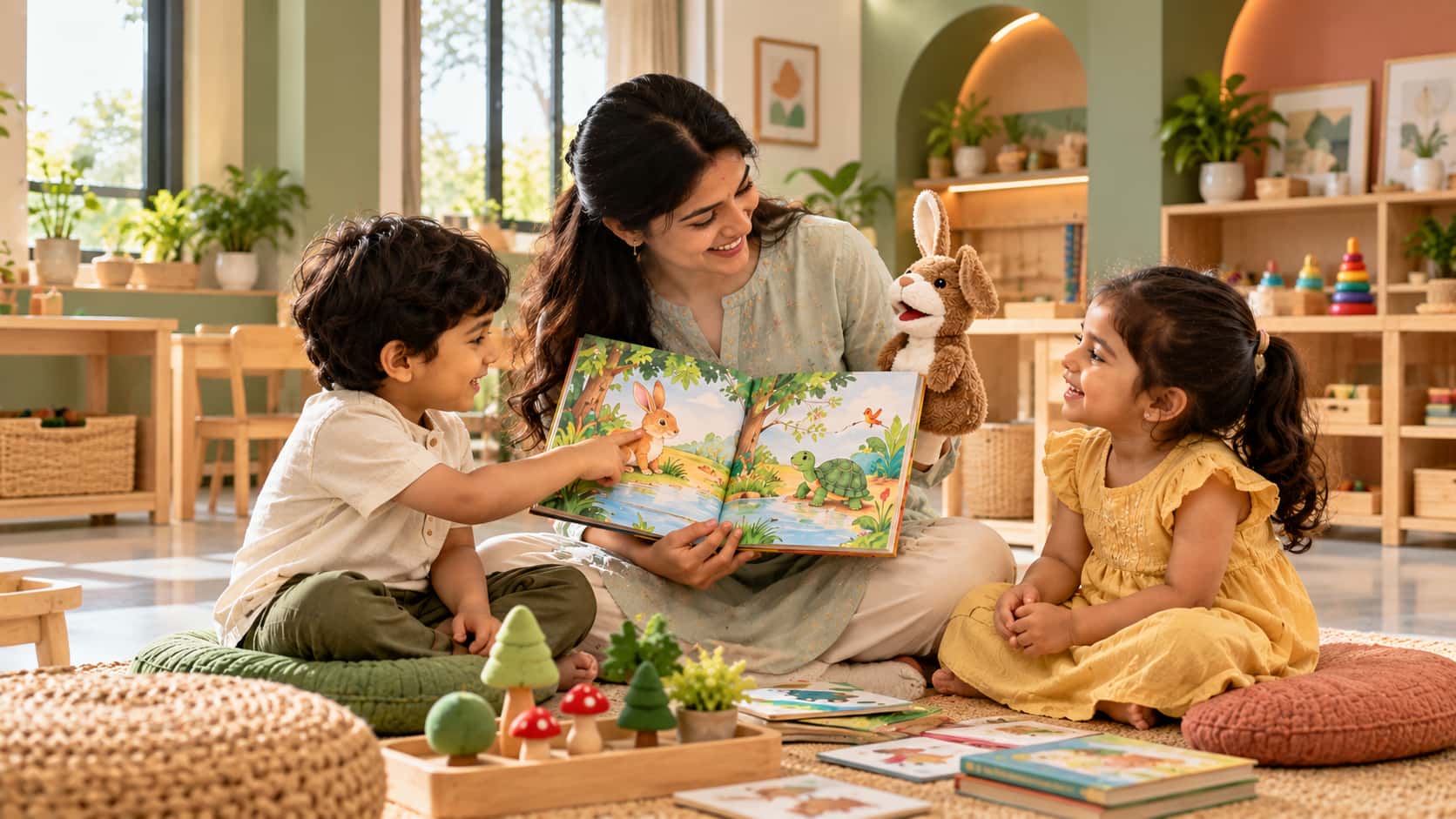
When children hear a story, they are doing much more than listening to words. They are imagining, predicting, remembering, asking questions and making sense of feelings. For parents of young children, that raises an important question: when does storytelling actually help, and what should it look like at different ages? This guide explains storytelling for kids in simple terms, from toddlers aged 18 months to 6-year-olds. You’ll learn what stories can build, activities you can try at home, and how storytelling fits naturally with Montessori learning.
What Is Storytelling for Kids?
Storytelling for children is more than reading a book aloud. It can involve voices, facial expressions, gestures, pictures, questions, puppets and conversations. A child may listen, respond, act, predict what happens next or tell part of the story themselves. The goal is participation, not sitting quietly until the story ends.
Why Storytelling Matters in Early Childhood
Stories give young children a natural reason to listen, speak, imagine and connect ideas. They also create small opportunities to practise skills without making learning feel like a lesson. What changes with age is how children participate, what they understand and how much of the story they can express themselves.
Builds Language and Vocabulary
Children hear new words in a meaningful context when they listen to stories. Repeated phrases, character conversations and simple questions give them chances to understand words first and gradually use them in their own speech.
Strengthens Listening Skills
A story encourages children to follow a sequence, notice changes and remember what happened earlier. When adults pause and ask simple questions, children practise listening for meaning rather than merely hearing sounds.
Encourages Imagination and Creativity
Stories give children characters, places and problems to picture in their minds. Once they become comfortable with familiar stories, they can change an ending, invent a character or imagine what might happen next.
Builds Confidence and Self-Expression
When children retell a story or speak as a character, they get a low-pressure way to use their voice. There is no single perfect answer, so children can gradually become more comfortable sharing ideas.
Helps Children Understand Emotions
Characters can experience happiness, fear, frustration, excitement or disappointment in ways children recognise.Talking about those moments helps children name feelings, notice other people’s perspectives and discuss different emotions safely. This kind of discussion can also support the development of emotional intelligence in children.
Encourages Social Interaction
Storytelling can become a shared experience rather than a one-way activity. Children take turns, listen to others, answer questions, act together and build on each other’s ideas, making stories a simple way to practise communication.
How Storytelling Benefits Children at Different Ages
Storytelling does not look the same at every stage. A toddler may enjoy repetition, rhythm and familiar pictures, while a five-year-old may create a longer plot or explain why a character behaved a certain way. Matching the activity to the child’s stage makes participation easier and more meaningful.
Storytelling for Children Aged 18 Months–2 Years
At this age, keep stories short, repetitive and highly interactive. Use familiar objects, animal sounds, gestures and simple pictures. Children may point, copy a sound, repeat a word or respond physically before they can retell a story.
Storytelling for 3–4-Year-Olds
Three- and four-year-olds can usually handle slightly longer stories with clear characters and simple problems. Invite them to predict what comes next, repeat favourite phrases, answer “why” questions and retell small parts using their own words.
Storytelling for 5–6-Year-Olds
Older preschoolers can begin handling more detailed plots, sequences and character motivations. Encourage them to retell the whole story, change an ending, create dialogue or explain what a character might be thinking or feeling.
What Happens During a Storytelling Activity?
A good storytelling activity is rarely just an adult speaking while children listen. It usually moves between listening, responding, moving, speaking and imagining. The exact mix depends on age, but the child should have regular chances to participate instead of remaining a passive audience.
Listening to the Story
Children first follow the story through words, pictures, gestures and voice changes. Short pauses can help them notice important details and stay involved, especially when the story is new or the child is still developing attention.
Asking and Answering Questions
Simple questions turn storytelling into a conversation. Ask what happened, what might happen next or how a character feels. For younger children, pointing and choosing between two possibilities can be enough to encourage a response.
Repeating Words and Phrases
Repetition gives children a comfortable way to join in. A familiar phrase, animal sound or character line can be repeated several times, helping children remember language while enjoying the rhythm and predictability of the story.
Acting Out Characters
Children can use their voice, face and body to become a character. Acting gives them another way to communicate when they do not yet have the words to explain every idea.
Retelling Parts of the Story
Retelling helps children organise events in sequence. They might describe the beginning, explain one favourite moment or use pictures as prompts. The focus should be on expressing the idea, not reproducing every sentence exactly.
Creating New Story Ideas
Once children understand the basic story, invite them to change something. A new animal, setting, problem or ending can turn listening into creative thinking and show children that stories can be shaped by their own ideas.
Simple Storytelling Activities for Young Children
You do not need expensive materials or elaborate preparation to make storytelling engaging. Simple activities such as puppets, picture stories and acting can make storytelling a form of fun-based learning for young children. Everyday objects, pictures and familiar routines can become story prompts. The best activity is one that matches the child’s age and gives them room to speak, imagine, move and make choices.
Picture-Based Storytelling
Choose three or four pictures and ask your child what they think is happening. Let them describe the characters, connect the pictures and invent a simple sequence. There is no need to correct every detail; focus on encouraging expression.
Puppet Storytelling
Use simple puppets, soft toys or paper characters to act out a story. Children can choose who speaks, make sounds and move characters around. This works especially well for children who enjoy hands-on play more than sitting with a book.
Story Retelling
After reading or telling a familiar story, invite your child to tell it back using pictures, toys or gestures. If they forget something, offer a gentle prompt rather than immediately supplying the answer.
Finish the Story
Start with a simple situation and stop before the ending. Ask your child what could happen next. Accept unusual ideas too. The purpose is to encourage prediction, imagination and language rather than find one correct ending.
Act Out a Character
Choose one character and let your child become them for a few minutes. Ask how the character walks, talks or feels. This combines movement, imagination and self-expression while making the story feel like play.
How Storytelling Supports Montessori Learning
Storytelling can fit naturally into Montessori-inspired learning when children are encouraged to participate rather than simply receive information. Giving children time to respond, retell and create also allows them to engage with Montessori learning at their own pace. It can support language development, independence, self-expression, imagination, observation and communication while allowing children to make choices and connect stories with their own experiences.
Language Development
Storytelling gives children meaningful opportunities to hear vocabulary, understand sentence patterns and express ideas. Montessori environments place strong value on language, and stories can support this naturally through conversation, picture work, repetition and child-led responses.
Independence
Children can choose a story, select a prop, decide how a character behaves or retell events in their own way. These small choices can support the confidence and independence Montessori encourages. These small choices let them take ownership of the activity instead of waiting for an adult to direct every step.
Self-Expression
Montessori learning respects the child’s individual way of communicating. Storytelling leaves room for different voices, ideas and interpretations, allowing children to express thoughts without needing to copy an adult’s exact words.
Imagination
Storytelling gives children space to create mental pictures, invent possibilities and explore situations beyond their immediate surroundings. When children create or modify stories themselves, imagination becomes something they actively use rather than something they only observe.
Observation
Stories can encourage children to notice facial expressions, actions, objects, settings and changes in a sequence. Asking what they see or what changed helps them slow down, pay attention and describe details using their own words.
Communication
Children learn that communication involves both speaking and listening, and storytelling gives them regular opportunities to practise these skills. This connects naturally with how Montessori improves communication skills through meaningful interaction. During shared storytelling, they practise taking turns, responding to questions, listening to another person’s idea and making their own message understandable to others.
How Parents Can Encourage Storytelling at Home
Storytelling at home does not need a fixed timetable or a special setup. It can easily become one of the simple preschool activities at home that gives children opportunities to speak, imagine and make choices. A few minutes during bedtime, playtime or a quiet afternoon can be enough. The key is to make conversation part of the experience and give your child permission to add ideas, ask questions and change the story.
Let Your Child Choose the Story
Offer two or three suitable stories and let your child choose. Giving them a small decision can increase interest and participation. If they repeatedly choose the same story, that is fine; repetition can be useful for young children.
Ask Open-Ended Questions
Instead of asking only questions with one correct answer, try “What do you think happens next?” or “Why do you think she did that?” Open-ended questions give children more room to explain, imagine and use language.
Encourage Your Child to Retell the Story
Ask your child to tell you what happened using their own words. You can use pictures or toys as reminders. If the sequence is mixed up, let them finish before gently helping them connect the events.
Use Props and Everyday Objects
A spoon can become a magic wand, a cushion can become a mountain and a toy can become a story character. Simple props make storytelling physical and playful without requiring parents to buy special materials.
Create Stories Together
Start with one sentence and take turns adding to it. You might introduce a character, while your child chooses the setting and the next event. This shared approach makes storytelling feel like a conversation rather than a performance.
What Should Parents Look for in a Storytelling Program?
If you are considering a storytelling program for your child, look beyond colourful materials or a long list of activities. The quality of participation matters more. A strong program should respect children’s ages, encourage communication and make space for creativity rather than expecting children to memorise stories.
Age-Appropriate Stories
Stories should match children’s attention span, language level and emotional understanding. Toddlers may need repetition and simple plots, while older preschoolers can explore longer sequences, richer vocabulary and more complex character situations.
Active Child Participation
Children should have chances to answer, move, act, choose, retell and create. If an activity is mostly an adult performing while children sit silently, it may offer less opportunity for children to practise storytelling skills themselves.
Opportunities for Self-Expression
Look for activities where children can use their own words, voices and ideas. A supportive program should not treat every variation as a mistake; children need room to communicate differently while gradually developing confidence.
A Safe and Encouraging Environment
Young children participate more freely when they feel comfortable making mistakes. Look for an environment where adults listen patiently, encourage attempts and avoid embarrassing children for being quiet, imaginative or different in their responses.
Learning Through Stories, Not Memorisation
The aim should be understanding, participation and expression rather than remembering every sentence. Children can benefit from knowing a story well, but they should also have opportunities to interpret it, change it and make it their own.
Conclusion
Storytelling can be a surprisingly powerful part of early childhood because it brings language, imagination, movement, emotions and social interaction together in one simple experience. For children aged 18 months to 6 years, the right approach changes with their development, but the goal stays similar: help children listen, think, communicate and create. Whether you tell stories at home or choose a storytelling program, look for opportunities where your child can participate, make choices and express ideas—not simply listen and repeat.
Frequently Asked Questions
At what age should children start storytelling?
Children can be introduced to storytelling from the toddler years, including around 18 months. At first, participation may look like pointing, copying sounds or repeating words. As language develops, children can gradually describe events and create simple stories.
How does storytelling help language development?
Storytelling exposes children to vocabulary, sentence patterns and conversations in a meaningful context. Repeated words and phrases can support understanding, while retelling and answering questions give children opportunities to practise expressing their own ideas.
Can storytelling improve a child's confidence?
It can give children regular opportunities to speak, act and share ideas in a supportive setting. Confidence can grow when children discover that their voice matters and that storytelling does not require one perfect answer.
Is storytelling suitable for toddlers?
Yes. Toddlers can enjoy very short stories with repetition, pictures, movement and familiar sounds. Keep expectations realistic: a toddler may participate by pointing, copying an action or saying one word rather than telling the whole story.
What are the best storytelling activities for preschoolers?
Picture stories, puppets, retelling, finishing an unfinished story and acting out characters are useful choices. The best activity depends on the child’s age, interests and language level, so variety is often more helpful than one fixed method.
How is storytelling connected to Montessori learning?
Storytelling can support Montessori principles when children actively participate, make choices and express their ideas. It can strengthen language, independence, observation, imagination and communication while keeping learning connected to the child’s curiosity and real experiences.