

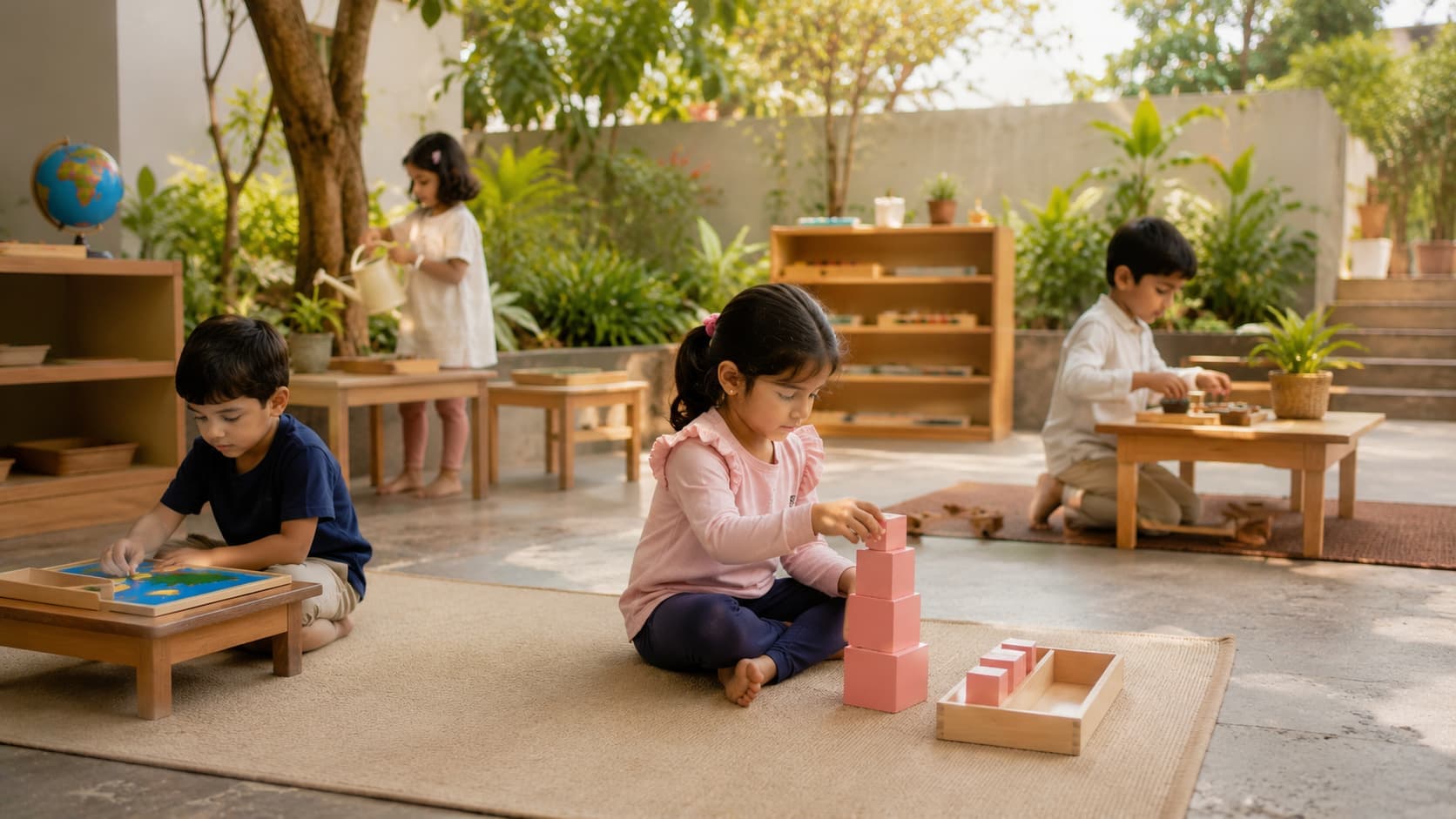
Every child has their own way of learning and their own time to get there.
While one child may quickly recognise letters, another may need more time to build fine-motor skills before writing. Some children learn through repetition, while others are ready for a new challenge after just a few attempts. Neither approach is wrong.
Montessori learning at their own pace respects these differences. Instead of rushing children to match a fixed timeline, Montessori gives them time to practise, explore and build confidence with guidance from teachers.
But how does this actually work in a Montessori classroom—and why can learning at an individual pace make such a difference?
What Does “Learning at Their Own Pace” Mean in Montessori?
Learning at their own pace does not mean children simply do whatever they want or that there are no expectations.
Montessori combines freedom with structure.
Children are introduced to carefully selected activities and Montessori materials by the teacher. They can then practise, repeat and explore those activities according to their level of readiness. The teacher observes the child and provides guidance or introduces the next activity when appropriate.
The American Montessori Society explains that children in Montessori environments can choose meaningful and challenging work at their own interest and ability level, while uninterrupted work periods give them time to become deeply engaged.
So, self paced learning is better understood as:
Freedom to learn + appropriate guidance + time to practise + respect for individual development.
Why Do Children Need Different Learning Speeds?
Children of the same age do not necessarily develop every skill at the same time.
One child might confidently speak in sentences but need more practice with fine-motor activities. Another might enjoy puzzles and numbers but take longer to participate in group conversations.
Development is not a perfectly straight line.
When children are constantly expected to match the pace of their classmates, they may become frustrated if they need more time or disengaged if they are ready for greater challenges.
A child centered learning environment can respond to these differences instead of treating them as problems.
This is one reason Montessori places considerable importance on observing the individual child.
The Association Montessori Internationale describes Montessori environments as child-centered spaces where trained adults observe both common developmental characteristics and the individual needs of each learner.
1. Children Can Spend More Time Practising a Skill
Learning something once does not mean a child has mastered it.
Montessori materials are designed to be used repeatedly. A child can return to an activity, practise it again and gradually become more confident.
For example, a child working with a practical-life activity may repeat the same sequence several times. The repetition is not wasted time. It can help the child develop coordination, concentration, order and independence.
This is particularly valuable for young children because mastery often comes through doing rather than simply being told how something works.
The Montessori approach gives children opportunities to repeat activities until they are ready to move forward. Montessori Australia notes that the prepared environment provides children with the time and space needed for development and purposeful activity.
2. Children Can Move Forward When They Are Ready
Self-paced learning is not only about giving children extra time.
It also means not holding a child back unnecessarily.
Suppose a child has become comfortable with a particular concept and shows interest in something more challenging. The teacher can observe that readiness and introduce an appropriate next activity.
This creates a more individualised learning journey.
Rather than saying, “Everyone must finish this today,” the Montessori approach considers questions such as:
- Is the child ready for the next step?
- Does the child need more practice?
- Is the child showing interest in another activity?
- Can the child work independently?
- What kind of guidance would be helpful?
This observation-based approach is an important part of Montessori education.
3. The Prepared Environment Supports Individual Learning
The Montessori classroom is designed around the needs of the child.
Materials are organised and made accessible so children can select purposeful activities within clear boundaries. The environment is intended to encourage independence, movement, concentration and exploration.
The Association Montessori Internationale describes Montessori environments as carefully prepared spaces with accessible furniture, learning materials and opportunities for hands-on, self-directed learning.
This matters because the environment itself becomes part of the learning process.
Instead of waiting for an adult to tell them what to do every moment, children gradually learn to:
- Choose an activity.
- Set up their workspace.
- Work with the material.
- Repeat or practise when needed.
- Complete the activity.
- Return the material.
- Choose what to do next.
These small routines can support growing independence.
4. Montessori Teachers Observe Before They Intervene
A Montessori teacher’s role is different from simply standing in front of a class and giving the same instruction to everyone.
Observation is an important part of understanding each child’s development.
The teacher watches how a child approaches an activity, where the child struggles, what interests the child and which skills appear ready for further development.
Based on these observations, the teacher can decide when to offer a presentation, when to allow further independent practice and when to introduce something new.
This is why Montessori individualized learning is not simply about children choosing activities. It also depends on thoughtful adult guidance.
A Montessori classroom still has structure, lessons and expectations. The difference is that these are adapted to the child’s developmental journey rather than relying entirely on one pace for everyone.
5. Repetition Can Build Confidence
Imagine a child trying an activity and not getting it right immediately.
Instead of being rushed to the next activity, the child may have the opportunity to try again.
With practice, the child may eventually complete the activity independently.
That experience can be meaningful.
The child learns more than the particular skill. They also experience something like:
“I couldn’t do it before, but I kept trying and now I can.”
This can support Montessori confidence and independence and a positive attitude toward learning.
Montessori environments are designed to encourage independence and purposeful engagement, with materials that allow children to explore and practise skills through hands-on activity.
6. Children Are Not Constantly Compared With Their Classmates
One of the useful aspects of a self-paced approach is that learning does not have to become a race.
A child who is still practising a particular skill does not necessarily need to feel that another child is “ahead.”
Montessori classrooms commonly include children of different ages within a developmental range. This can create opportunities for younger children to observe older classmates and for older children to develop responsibility and social skills.
The mixed-age environment can also reduce the pressure of expecting every child to reach every milestone at exactly the same moment.
For parents, this is an important distinction:
Individual pace does not mean lack of progress. It means progress is understood in relation to the individual child.
7. Hands-On Materials Make Self-Paced Learning Practical
Young children often learn through movement, touch and repeated experience.
Montessori materials give children something concrete to work with rather than relying only on verbal explanations.
Depending on the activity, children may sort, match, count, build, arrange, trace, transfer, classify or explore.
Many Montessori materials are also designed to isolate particular concepts or skills, allowing children to focus their attention on what they are learning.
The American Montessori Society describes Montessori early childhood learning as hands-on and notes that activities can be selected according to a child’s interest and ability level.
This makes it easier for children to practise according to their own level of understanding while developing Montessori problem-solving skills through hands-on activities.
8. Self-Paced Learning Can Encourage Concentration
Children need time to concentrate.
If an activity is interrupted too frequently, a child may not have enough opportunity to become deeply involved in it.
Montessori environments therefore place importance on uninterrupted periods of purposeful work. The American Montessori Society notes that Montessori work periods are typically long enough to allow children to work at their own pace and become immersed in activities.
When children can stay with an activity for an appropriate amount of time, they can experience the process of:
Choosing → practising → concentrating → completing → reflecting → choosing again
Over time, these experiences can contribute to greater independence and responsibility.
9. Learning at Their Own Pace Does Not Mean Learning Without Boundaries
This is one of the most common misunderstandings about Montessori.
A Montessori classroom is not an environment where children can ignore rules or avoid learning.
There are clear expectations around how materials are used, how children interact with one another and how the classroom environment is maintained.
Children have freedom within limits.
They may have choices, but those choices exist inside a carefully prepared environment with appropriate materials and guidance.
This balance is important. Too much control can reduce independence, while unlimited freedom can make it difficult for young children to develop self-discipline.
Montessori aims to provide both.
What Does Self-Paced Montessori Learning Look Like in Practice?
A simple example can make the idea easier to understand.
Imagine two children working in the same Montessori classroom.
Child A is exploring a language activity and quickly understands the concept. After demonstrating readiness, the teacher can introduce another activity that builds on that skill.
Child B is working with the same general area but needs more repetition. The child can continue practising rather than being rushed simply because another child has moved ahead.
Both children are learning.
They are simply at different points in their individual learning journeys.
That is the heart of Montessori personalized learning.
Does Learning at Their Own Pace Mean Children Can Fall Behind?
Not necessarily.
A self-paced Montessori environment is not the same as leaving children without direction.
Teachers observe children’s development and introduce activities progressively. Montessori materials and lessons are organised so that children can build from simpler experiences toward more complex ones.
The goal is not simply to let a child stay with an easy activity forever. The teacher’s role includes recognising when the child needs encouragement, further practice or a new challenge.
Research and professional literature on Montessori describes this combination of child choice, teacher guidance and structured environments as central to the approach.
Parents should also remember that every educational approach has to be implemented well. The quality of the classroom environment, teacher preparation, observation and consistency matters.
How Parents Can Support Self-Paced Learning at Home
Parents do not need to recreate a Montessori classroom at home.
Instead, they can create small opportunities for independence.
For example:
- Give your child enough time to finish simple tasks without immediately helping.
- Let your child make age-appropriate choices.
- Encourage practical activities such as tidying toys, pouring water or organising belongings.
- Avoid comparing your child’s development with another child’s.
- Praise effort, concentration and persistence rather than only correct answers.
- Allow children to repeat activities they enjoy.
- Offer simple activities that match their current abilities.
- Step in when help is genuinely needed rather than solving every problem immediately.
The aim is not to make every moment educational.
Children also need unstructured play, rest, conversation and family time.
What Should Parents Look For in a Montessori School?
If you are considering Montessori schools in Bangalore, don’t choose a school based only on the word “Montessori” in its name.
During a school visit, look at what actually happens in the environment.
You can ask:
- How do teachers observe each child’s development?
- How are activities introduced?
- Do children have opportunities to repeat activities?
- How much independent work do children do?
- How does the school support children who need more time?
- How are children challenged when they are ready for the next step?
- What Montessori materials are available?
- How does the classroom maintain freedom while setting boundaries?
- How do teachers communicate children’s progress with parents?
Parents interested in joining the school can also review the Montessori admission process before planning their next steps.
Look for an environment where children appear engaged, purposeful and respected—not simply busy.
Why This Approach Matters for Parents in Bangalore
For families searching for Montessori education in Bangalore, the biggest question may not be whether Montessori is “better” than every other preschool approach.
A more useful question is:
Does this learning environment match the way my child learns and develops?
If your child benefits from hands-on exploration, repetition, independence and time to become comfortable with new skills, learning more about kids who benefit from Montessori may help you decide if this approach is suitable.
The right school should also be one where you feel confident about the educators, environment, communication and overall approach to your child’s development.
Cherubs Montessori describes itself as a nurturing early learning centre focused on giving children a strong foundation during their early developmental years. Its website also highlights a secure, hygienic and child-friendly environment.
Cherubs Montessori currently lists campuses in HSR Layout, Sompura and Jayanagar, Bengaluru, along with programmes including DayCare and Montessori levels.
Conclusion
Children do not all learn in the same way or at the same speed.
That is why Montessori learning at their own pace focuses on giving children appropriate choices, hands-on experiences, repetition and enough time to develop skills while a teacher observes and guides them.
The goal is not to remove structure or expectations. It is to create a learning environment where children can progress without unnecessary pressure and gradually become more independent in the process.
For parents, the best way to understand this approach is to see it in action.
Book a Visit to Discover How Your Child Can Learn and Grow at Their Own Pace at Cherubs Montessori.
Frequently Asked Questions
How does Montessori allow children to learn at their own pace?
Montessori allows children to choose from appropriate activities, repeat work when needed and progress to new challenges when they are ready. Teachers observe each child and provide guidance based on individual development.
Is Montessori completely self-directed?
No. Montessori combines child choice with structure and teacher guidance. Children have freedom within clear boundaries and are introduced to activities by the teacher.
How does Montessori support different learning speeds?
Children can spend different amounts of time practising activities and can move forward when they demonstrate readiness. This reduces the expectation that every child must master a skill at exactly the same time.
Does Montessori help children become independent?
Independence is an important part of Montessori education. Children are encouraged to make appropriate choices, care for materials, complete activities and gradually manage more tasks on their own.
Is Montessori suitable for every child?
No single educational approach is automatically the right fit for every child. Parents should consider their child’s temperament, needs and learning preferences, and visit the school to understand how the Montessori environment is actually implemented.