

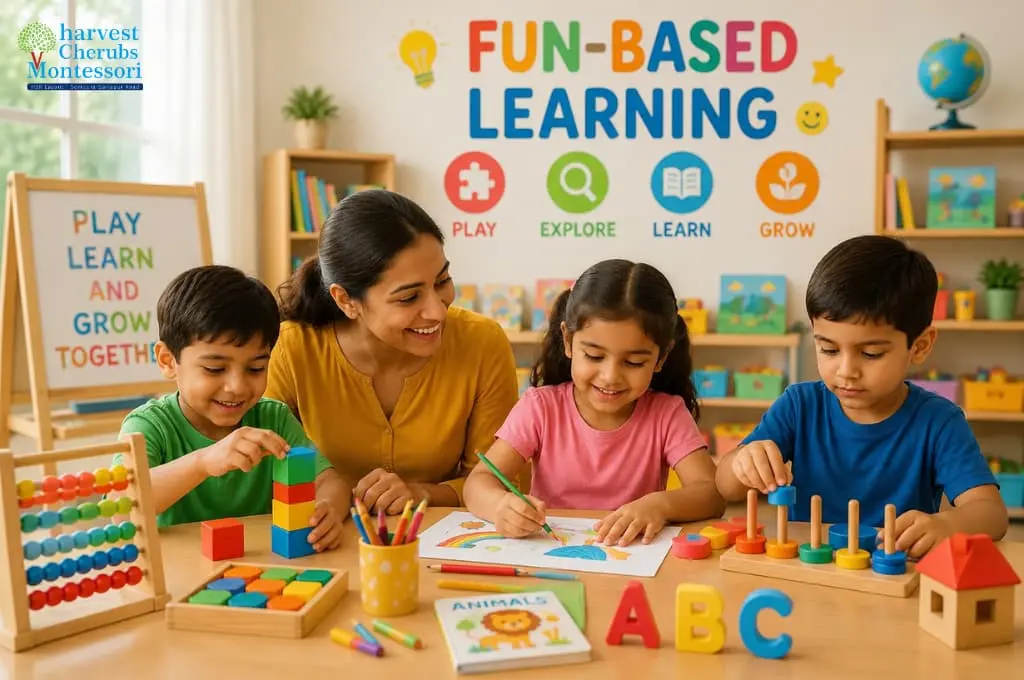
Fun-based learning for young children is one of the most effective ways to support early development. Kids naturally learn better when they enjoy what they’re doing. However, traditional methods often focus on memorizing and repetition, which can feel boring and stressful for young minds.
That’s where fun-based learning makes a difference. It turns learning into an enjoyable experience instead of a task. In this blog, you’ll understand the importance of fun learning in early childhood and how it helps children grow faster.
What is Fun-Based Learning and Play-Based Learning for Preschoolers?
Fun-based learning focuses on teaching through activities, games, and interaction. It is closely connected with play-based learning for preschoolers, where children learn by doing rather than just listening.
For example, instead of reading about numbers, children can learn counting through blocks or toys. Drawing and coloring help them understand shapes and colors in a fun way.
This approach also includes interactive learning for kids and simple early childhood learning activities, which keep children engaged and active throughout the learning process.
Why the Importance of Fun Learning in Early Childhood Matters
The importance of fun learning in early childhood lies in how it supports natural curiosity. Children love to explore, ask questions, and experiment.
When learning feels enjoyable:
- Children stay focused
- They understand concepts faster
- They feel less pressure
This also helps to build confidence in children from an early stage.
Key Benefits of Fun-Based Learning for Young Children
Understanding the benefits of fun-based learning helps parents choose better learning methods.
Better Understanding
Children learn concepts clearly through hands-on activities.
Improved Creativity
Drawing, storytelling, and play boost imagination.
Stronger Social Skills
Group activities improve communication and teamwork.
Emotional Confidence
Fun learning builds confidence and reduces fear of learning, helping children build confidence and independence over time.
Methods: Montessori Method of Education and Interactive Learning for Kids
Play-Based Learning for Preschoolers
Learning through toys and games keeps children engaged.
Montessori Method of Education
The Montessori method of education focuses on hands-on learning and independence.
Interactive Learning for Kids
Activities like storytelling and discussions encourage interactive learning for kids.
Preschool Activities at Home for Early Childhood Learning Activities
Parents can support learning with simple preschool activities at home:
- Counting games using daily objects
- Drawing and coloring
- Storytelling
- Outdoor play
These are easy early childhood learning activities that improve both learning and development.
Conclusion
Fun-based learning for young children is a simple yet powerful approach. It makes learning enjoyable, improves understanding, and builds confidence at an early age.
Instead of forcing children to learn, making it fun creates a strong foundation for their future. Many preschools today are adopting this method to support better child development, including Cherubs Montessori, where learning is designed to be engaging and child-focused.
Simple takeaway: When children enjoy learning, they grow faster and learn better.