

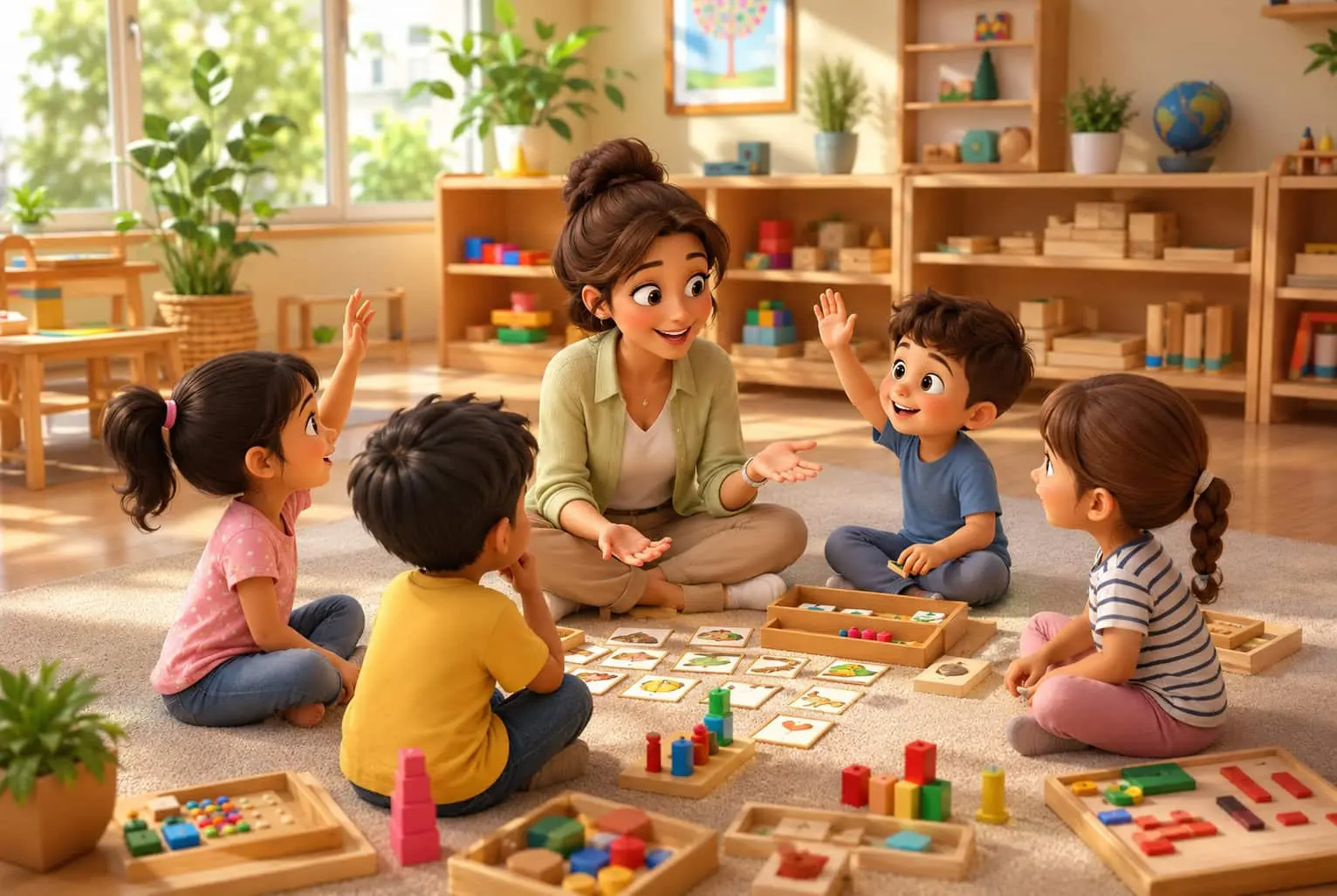
Communication is more than just learning to speak—it’s the foundation of a child’s confidence, relationships, and lifelong learning. During the early years, the right learning environment can make a lasting difference in how children express themselves, listen, and connect with others.
The Montessori method nurtures Montessori communication skills through hands-on learning, meaningful conversations, and real-life experiences that encourage children to communicate with confidence. If you’re exploring the benefits of Montessori education or looking for the best Montessori school in Bangalore, this guide explains how Montessori supports language development and helps children become confident communicators from an early age.
AI Summary
Montessori education supports communication development by creating an environment where children naturally practice speaking, listening, expressing ideas, and interacting with others. Through hands-on learning, mixed-age classrooms, practical life activities, and teacher guidance, children develop confidence, vocabulary, emotional awareness, and social communication skills that prepare them for lifelong learning.
Why Communication Skills Matter in Early Childhood
The early years are a critical period for developing language, listening, and social interaction. During this stage, children rapidly build vocabulary, learn to understand emotions, and begin expressing their thoughts with increasing confidence. These communication skills in children influence not only academic success but also relationships, emotional well-being, and problem-solving abilities throughout life.
Strong communication skills help children:
- Express needs and feelings clearly.
- Build healthy friendships.
- Develop confidence in new situations.
- Improve listening and comprehension.
- Strengthen early literacy and learning abilities.
Research in early childhood education consistently shows that children who experience rich language environments are more likely to become confident communicators and engaged learners.
Understanding Montessori Communication Skills
The Montessori method views communication as more than just speaking. It encourages children to listen carefully, express their ideas confidently, and build vocabulary through meaningful, real-life experiences. In a Montessori classroom, teachers guide conversations, introduce new words, and create opportunities for natural communication throughout the day.
Mixed-age learning further supports speech and language development, while the Montessori classroom also encourages leadership, collaboration, and confidence through peer learning.
How the Montessori Method Supports Language Development
One of the key Montessori education benefits is its focus on Montessori language development through everyday experiences. Rather than teaching language as a separate subject, the Montessori learning method encourages children to communicate naturally during classroom activities, practical life exercises, and interactions with peers and teachers.
Children are encouraged to observe, ask questions, describe their experiences, and express their ideas with confidence. This hands-on approach supports language development in children, strengthens speech and language development, and helps them become effective communicators.
For example, during a practical life activity like arranging flowers, teachers ask open-ended questions such as, “What colour are these flowers?” or “Why do plants need water?” These simple conversations expand vocabulary, improve critical thinking, and strengthen Montessori communication skills. They also encourage children to develop problem-solving abilities through the Montessori method.
Key Montessori Activities That Build Communication Skills
Children learn best when communication happens naturally rather than being forced. One of the biggest strengths of the Montessori learning method is that every activity becomes an opportunity to speak, listen, observe, and interact.
Instead of memorizing words from worksheets, children develop language while engaging in meaningful experiences. These activities improve Montessori communication skills because they connect vocabulary with real-life situations.
Practical Life Activities
Practical life activities are one of the first experiences children encounter in a Montessori classroom. Tasks such as pouring water, folding clothes, arranging flowers, serving snacks, or cleaning a table encourage children to follow instructions, ask for help, and describe what they are doing.
These activities support:
- Vocabulary development
- Listening skills
- Following directions
- Respectful conversation
- Confidence in expressing needs
For example, while preparing a snack, children naturally learn words related to food, colours, textures, quantities, and actions. The teacher guides the conversation without dominating it, allowing children to express themselves freely.
Storytelling and Language Materials
Montessori classrooms include carefully designed language materials that gradually build speaking, reading, and writing skills.
Children participate in:
- Storytelling
- Picture discussions
- Vocabulary cards
- Sound games
- Rhyming activities
- Object naming exercises
Rather than simply teaching words, these activities help children understand meaning, context, pronunciation, and sentence formation.
Grace and Courtesy Lessons
One unique feature of Montessori education is the emphasis on Grace and Courtesy lessons. These lessons teach children how to communicate respectfully in everyday situations.
Children learn how to:
- Greet others politely.
- Wait for their turn.
- Listen without interrupting.
- Say “please” and “thank you.”
- Resolve conflicts calmly.
- Express feelings respectfully.
These lessons play a significant role in developing both communication skills in children and social skills in children.
Collaborative Learning
Unlike competitive classrooms, Montessori encourages cooperation.
Children frequently:
- Work together.
- Ask each other questions.
- Explain activities.
- Help younger classmates.
- Solve problems as a group.
This daily interaction builds confidence while improving verbal communication and active listening.
The Role of the Montessori Classroom in Communication Development
A prepared Montessori environment is intentionally designed to encourage interaction without creating pressure.
Everything—from the classroom layout to the teacher’s role—supports communication.
Instead of standing at the front of the class giving constant instructions, Montessori teachers observe children, introduce new vocabulary naturally, and encourage thoughtful conversations.
The classroom itself encourages communication because children are free to move, collaborate, ask questions, and discuss their work.
This creates a language-rich environment where communication becomes part of everyday learning rather than a separate lesson.
Montessori vs Traditional Preschool: Which Supports Communication Better?
| Feature | Montessori Preschool | Traditional Preschool |
|---|---|---|
| Learning Style | Child-led exploration | Teacher-led instruction |
| Communication | Natural conversations throughout the day | Mostly classroom discussions |
| Teacher’s Role | Guide and facilitator | Primary instructor |
| Collaboration | Mixed-age peer learning | Same-age classroom |
| Independence | Highly encouraged | Moderately encouraged |
| Language Learning | Integrated into all activities | Often taught separately |
| Social Interaction | Continuous | Scheduled group activities |
Benefits Beyond Communication Skills
Communication is only one outcome of Montessori education. As children become more confident speakers, they also develop a wide range of life skills.
Independence
One of the most valuable Montessori education benefits is helping children become independent from an early age. Through practical life activities and everyday responsibilities, children learn to make decisions, solve simple problems, and communicate their needs with confidence. As they complete tasks independently, they develop a sense of responsibility, self-reliance, and confidence that supports both learning and everyday life, making independence one of the most valuable Montessori education benefits.
Children gradually develop:
- Decision-making skills
- Problem-solving abilities
- Responsibility for daily tasks
- Independent thinking
- Confidence in expressing their needs
Emotional Development
Strong communication begins with understanding emotions. The Montessori method encourages children to recognize their feelings, express them respectfully, and understand the emotions of others. Through collaborative learning, classroom discussions, and everyday interactions, children develop empathy and learn to communicate thoughtfully, helping them build healthy relationships with both peers and adults.
These experiences strengthen:
- Emotional intelligence
- Empathy
- Self-awareness
- Self-regulation
- Respect for others’ feelings
- Healthy emotional expression
Leadership Skills
A unique feature of the Montessori classroom is its mixed-age learning environment, where children naturally develop leadership and communication skills. Older children guide and support younger classmates by explaining activities, demonstrating tasks, and offering encouragement. These meaningful interactions build confidence, responsibility, teamwork, and clear communication while preparing children to become thoughtful and compassionate leaders.
Children develop leadership by:
- Explaining activities to younger peers
- Communicating instructions clearly
- Working collaboratively in groups
- Building teamwork and cooperation
- Taking responsibility for shared tasks
- Leading with confidence and empathy
How Parents Can Support Communication Skills at Home
Parents play an equally important role in developing their child’s communication skills. While a Montessori classroom provides a strong foundation, consistent support at home helps children practice speaking, listening, and expressing themselves with greater confidence. Simple daily interactions and meaningful conversations can reinforce what children learn through the Montessori approach, making communication a natural part of their everyday lives. By creating a language-rich environment at home, parents can further strengthen their child’s vocabulary, confidence, and overall communication abilities.
Talk During Everyday Activities
Instead of asking only yes-or-no questions, encourage conversations.
For example:
Instead of asking:
“Did you enjoy school?”
Try asking:
“What made you smile today?”
or
“Can you tell me about your favourite activity?”
These open-ended questions encourage children to think and communicate more effectively.
Read Together Every Day
Reading aloud introduces new vocabulary while improving listening, imagination, and comprehension.
Pause occasionally to ask:
- What do you think will happen next?
- Why did the character feel happy?
- What would you do differently?
Reduce Passive Screen Time
While educational content can be beneficial in moderation, excessive passive screen time often replaces valuable face-to-face conversations and interactive learning experiences. Encouraging children to participate in hands-on activities gives them more opportunities to ask questions, share ideas, and build their vocabulary naturally. These everyday experiences play an important role in strengthening language development in children and improving overall communication skills.
Instead of spending long hours on screens, encourage activities such as:
- Storytelling and reading together
- Drawing and describing their artwork
- Role play and pretend games
- Outdoor exploration and nature walks
- Singing songs and nursery rhymes
- Family conversations during meals
These activities create meaningful interactions that help children become confident communicators while reducing the negative impact of screen time in preschoolers.
Encourage Practical Life Activities
Children naturally enjoy helping with everyday household tasks, and these moments can become excellent opportunities to build communication skills. As children participate in simple responsibilities, parents can engage them in conversations by asking questions, introducing new vocabulary, and encouraging them to explain what they are doing. This not only reinforces practical life activities learned in a Montessori environment but also promotes independence, confidence, and language development.
Simple activities include:
- Watering plants and talking about plant growth
- Folding clothes while naming colours and clothing items
- Setting the dining table by identifying utensils and counting plates
- Organising toys by discussing shapes, sizes, and categories
- Helping prepare simple snacks while learning new food-related words
- Tidying their room while following and giving simple instructions
These everyday interactions transform routine tasks into valuable learning experiences. Parents can also include preschool activities at home to further strengthen communication, creativity, and independent learning.
Signs Your Child's Communication Skills Are Improving
Communication skills develop gradually through consistent learning and everyday interactions. As children grow, they become more confident in expressing their thoughts, understanding others, and participating in conversations, reflecting steady progress in their language and social development.
Parents may notice improvements such as:
- Using longer sentences.
- Asking more thoughtful questions.
- Speaking confidently with adults.
- Playing cooperatively with friends.
- Explaining ideas clearly.
- Listening without frequent interruptions.
- Expressing emotions using words instead of frustration.
- Showing curiosity during conversations.
These small milestones indicate healthy communication development in early childhood.
Common Mistakes Parents Should Avoid
Even with the best intentions, certain everyday habits can unintentionally slow a child’s communication development. Creating a supportive and patient environment allows children to express themselves freely, build confidence, and develop stronger communication skills over time.
Avoid these common mistakes:
- Answering for your child before they have a chance to respond.
- Correcting every small grammar mistake during conversations.
- Rushing children when they are trying to express themselves.
- Comparing your child’s speech or progress with others.
- Depending too heavily on digital devices for learning.
- Interrupting children while they are speaking.
- Asking only yes-or-no questions instead of encouraging conversation.
Instead, give children time, patience, and positive encouragement. Listen attentively, appreciate their efforts, and create opportunities for meaningful conversations. When children feel heard, respected, and supported, they become more confident communicators and develop a lifelong love for expressing their thoughts and ideas.
Expert Tips for Building Strong Communication Skills
Communication develops through consistent everyday experiences rather than occasional lessons.
Experts recommend:
- Speak respectfully with your child.
- Introduce new vocabulary naturally.
- Encourage storytelling.
- Read together every day.
- Create opportunities for social interaction.
- Allow children to solve small problems independently.
- Celebrate effort rather than perfection.
These simple habits complement the learning environment found in a Montessori preschool.
Best Practices for Choosing a Montessori Preschool
If communication development is one of your priorities, look for a preschool that offers:
- Certified Montessori-trained educators.
- Language-rich classrooms.
- Mixed-age learning environments.
- Practical life activities.
- Small teacher-child ratios.
- Safe and welcoming learning spaces.
- Opportunities for collaborative learning.
- Regular parent communication.
For parents searching for the Best Montessori School in Bangalore or a Montessori Preschool in Bangalore, understanding how to choose the right preschool can help you make a confident admission decision.
Conclusion
Strong communication skills are built through everyday experiences, meaningful conversations, and a supportive learning environment—not through memorization alone. The Montessori approach nurtures confident communicators by encouraging children to observe, express ideas, listen actively, and interact respectfully with others.
From Montessori language development and practical life activities to collaborative learning and emotional growth, every aspect of the Montessori method contributes to a child’s ability to communicate with confidence. These early skills not only prepare children for academic success but also help them build healthy relationships and become independent, lifelong learners.
If you’re exploring a Montessori Preschool in Bangalore, choose a school that provides an authentic Montessori environment where communication, curiosity, and confidence are encouraged every day.
FAQs
How does Montessori help improve communication skills in children?
The Montessori method improves communication skills by encouraging children to engage in meaningful conversations, practical life activities, storytelling, and collaborative learning. These daily experiences help children develop vocabulary, listening skills, confidence, and the ability to express their thoughts clearly.
At what age do children start developing communication skills in Montessori?
Children begin developing communication skills from the moment they enter a Montessori preschool, typically between 2 and 6 years. During these formative years, they build language, social, and emotional skills through guided interactions and hands-on learning.
Why is communication important in early childhood?
Communication is essential because it helps children express their emotions, build relationships, solve problems, and develop confidence. Strong communication skills also support academic success, emotional well-being, and lifelong learning.
Does Montessori help shy children become more confident?
Yes. A Montessori classroom provides a supportive, non-competitive environment where children are encouraged to communicate at their own pace. Small group activities, mixed-age learning, and positive teacher guidance help shy children gradually gain confidence.
What Montessori activities improve communication skills?
Several Montessori activities naturally support communication development, including:
- Practical life activities
- Storytelling and picture discussions
- Grace and Courtesy lessons
- Role play
- Group learning activities
- Sensory exploration
- Reading aloud
How can parents improve communication skills at home?
Parents can strengthen communication by:
- Reading together every day
- Asking open-ended questions
- Encouraging storytelling
- Limiting passive screen time
- Involving children in daily household activities
- Listening patiently without interrupting
These habits reinforce what children learn in Montessori.
What is the role of teachers in Montessori communication development?
Rather than giving constant instructions, Montessori teachers act as guides. They introduce new vocabulary, ask thoughtful questions, observe each child’s progress, and create opportunities for meaningful conversations that support Montessori language development.
How do mixed-age classrooms improve communication?
Mixed-age classrooms encourage younger children to learn by observing older peers, while older children strengthen their communication and leadership skills by mentoring younger classmates. This promotes confidence, empathy, and effective social interaction.
Is Montessori better than a traditional preschool for communication skills?
Both approaches support language development, but Montessori integrates communication into everyday learning rather than teaching it only during language lessons. This helps children practice speaking and listening naturally throughout the day.
How do I choose the best Montessori preschool in Bangalore?
When selecting a preschool, look for:
- Certified Montessori-trained teachers
- Authentic Montessori classrooms
- Practical life activities
- Mixed-age learning
- Safe and child-friendly environment
- Positive parent reviews
- Transparent admission process
Visiting the campus and interacting with teachers can help you determine whether the learning environment is the right fit for your child.