

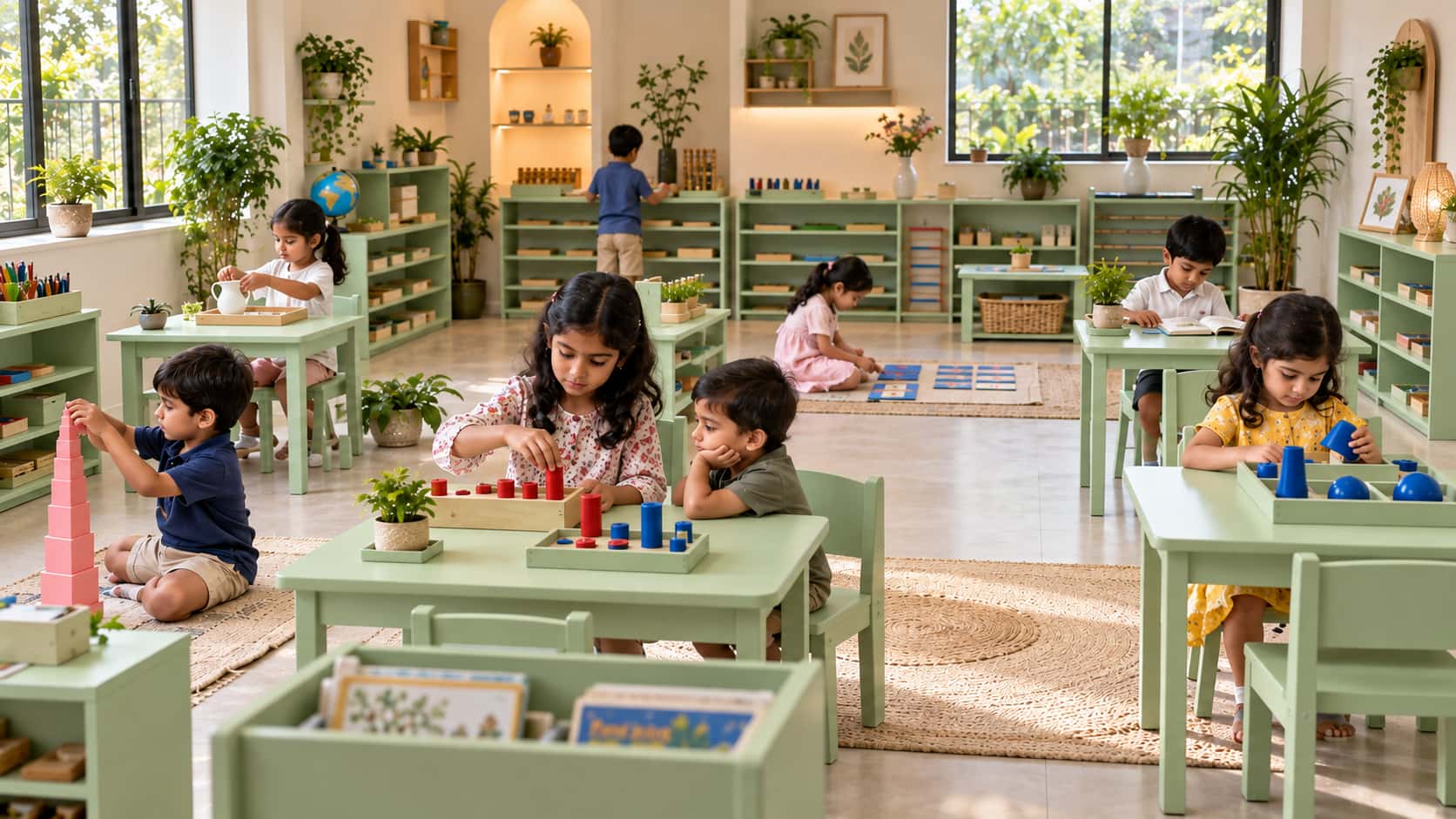
Children do not all learn at the same pace. One child may be ready to read independently while another is still developing language, coordination, or confidence. Montessori mixed-age classrooms are designed around this natural variation rather than expecting every child of the same age to progress in exactly the same way. By bringing children of different ages together, the classroom can create opportunities for independence, peer learning, leadership, cooperation, and observation. But what does this actually look like during a child’s day, and why can learning alongside older and younger classmates be so valuable?
What Is a Montessori Mixed-Age Classroom?
A Montessori mixed-age classroom brings children from different age groups together in the same learning environment instead of separating them strictly by birth year.
The exact age range depends on the Montessori program, but a common approach is to have children remain in the same classroom community for several years. This gives them time to become familiar with the environment, develop independence, and gradually move from being younger members of the group to becoming more experienced ones.
That progression matters.
A younger child can watch an older classmate work with materials, communicate with others, solve a problem, or complete a task independently. Over time, the younger child becomes more capable and may eventually provide that same kind of example for someone new.
The classroom therefore becomes more than a place where children receive lessons from an adult. It becomes a small community in which children can learn from one another as well.
How Do Mixed-Age Classrooms Support Learning?
One of the biggest advantages is that children are not always expected to learn something simply because they have reached a particular age. This approach also supports learning at their own pace allowing children to engage with activities according to their individual readiness and development.
In a Montessori environment, learning materials and activities are generally introduced according to a child’s readiness and development. A classroom containing children at different stages makes this approach more practical because there is already a natural range of abilities within the group.
For example, a younger child might be working on an activity that develops coordination and concentration while an older child is working independently on more advanced language or mathematics. Both children can be engaged in meaningful work without one being treated as “behind” simply because another child is further ahead.
This can create a calmer approach to learning.
Instead of constantly comparing children with classmates of exactly the same age, the emphasis can shift toward individual progress.
Younger Children Learn by Watching Older Children
Children often learn by observing what happens around them.
In a mixed-age Montessori classroom, younger children have the opportunity to see older classmates using materials, following classroom routines, solving problems, communicating respectfully, and completing increasingly complex work.
An older child does not need to formally teach the younger child for this observation to be useful.
Sometimes simply seeing another child perform an activity can make a new task feel familiar. The younger child can begin to understand how the classroom works and what kinds of activities may eventually become available to them.
There is also an emotional benefit. A child entering a new classroom does not have to figure everything out alone. They are joining an established community where other children already understand the routines.
That sense of familiarity can help a child gradually become more comfortable and independent.
Older Children Develop Leadership and Responsibility
The benefits do not stop with the younger children.
Older students can gain valuable experience from being among younger classmates. They may have opportunities to demonstrate activities, help someone understand a classroom routine, or simply become a positive example for others.
This is different from making older children responsible for teaching younger ones.
The goal is not to turn children into miniature teachers. Rather, the mixed-age environment can give older children natural opportunities to practise patience, communication, responsibility, and leadership. These experiences can contribute to early leadership skills in Montessori classrooms by giving children opportunities to guide, cooperate and become positive role models.
A child who once needed help carrying out a particular classroom activity may later be the one who knows exactly where the materials belong or how a classroom routine works.
That change can strengthen a child’s sense of competence.
Mixed-Age Classrooms Can Encourage Independence
Independence is a central idea in Montessori education, and the mixed-age structure can support it in a practical way. You can also learn more about how Montessori builds confidence and independence in children through everyday learning experiences.
When children see classmates working independently, they are exposed to a classroom culture in which doing things for oneself is normal.
They may learn to collect and return materials, care for their surroundings, make appropriate choices, complete activities, and seek help when necessary.
Importantly, independence does not mean that children are expected to manage everything without support.
A well-prepared classroom still provides guidance. The difference is that adults can encourage children to participate actively in their own learning rather than immediately doing tasks for them.
Children Can Learn Cooperation Without Constant Competition
A classroom made up entirely of children at the same developmental stage can naturally encourage comparison. Who finished first? Who can read the most words? Who completed the activity correctly?
Mixed-age classrooms can create a different social dynamic.
Children have different strengths, interests, and levels of experience. Because the differences are visible every day, learning does not have to be framed as a race between classmates.
A younger child may have strengths that an older child does not. An older child may have knowledge that a younger child is still developing.
This creates opportunities for cooperation rather than making every difference a competition.
Of course, mixed-age classrooms do not eliminate disagreements or social challenges. Children still need guidance in resolving conflicts and communicating with one another. The advantage is that the classroom provides many opportunities to practise those skills in a real community.
Staying in the Same Classroom Can Help Build Relationships
Another often-overlooked benefit is continuity.
When children remain within the same classroom community for more than one year, relationships can develop over time. Teachers become familiar with individual children’s personalities, interests, strengths, and areas where they need support.
Children also get to experience different roles within the same community.
At first, they may be among the youngest and least experienced. Later, they become more confident and capable. Eventually, they may become one of the older children others look toward.
That progression can help children see growth as something that happens gradually.
They are not simply moving from one age-labelled classroom to another. They are developing within a community that they already understand.
Does Every Child Automatically Benefit From a Mixed-Age Classroom?
Not necessarily.
The quality of the classroom matters enormously. Simply putting different ages together does not automatically create a strong Montessori environment.
The adults, classroom preparation, materials, routines, group dynamics, and individual support all influence a child’s experience.
Parents considering a Montessori program should therefore look beyond the phrase “mixed-age classroom.”
Ask how children are introduced to the environment. Ask how teachers support children who need additional help. Ask how older children are encouraged to develop leadership without being given inappropriate responsibility. Most importantly, observe how the children actually interact.
Do they appear engaged?
Are they able to work independently?
Does the classroom feel orderly without being overly rigid?
Do teachers know when to step in and when to give a child space to solve a problem independently?
Those observations can tell you much more than the classroom’s age range alone.
What Parents Should Look For in a Montessori Mixed-Age Classroom
The mixed-age structure is only one part of the Montessori experience. When visiting a school, look at the environment as a whole.
A useful classroom will generally have clearly organised materials, opportunities for independent activity, predictable routines, and adults who understand that children develop at different rates.
It is also worth asking how the school handles transitions. A child may need time to become comfortable before working independently, and the approach to that transition can vary between classrooms.
Rather than asking only, “What ages are in this classroom?” Parents can also use this checklist when learning how to choose the right preschool.
– How long do children typically remain in the classroom?
– How are activities introduced?
– How do teachers support different levels of ability?
– How are children encouraged to solve problems independently?
– How are older children supported in becoming positive role models?
– How does the classroom handle conflict between children?
– How do teachers communicate children’s progress with parents?
These questions help you understand whether the mixed-age structure is being used thoughtfully rather than simply being an organisational choice.
The Bigger Benefit: Children Learn to Be Part of a Community
Perhaps the most valuable feature of a mixed-age Montessori classroom is that children are learning more than academic skills.
They are learning how to exist within a community.
They see that people have different abilities. They experience being helped and, later, helping others. They learn that becoming capable takes time. These everyday experiences can also help children develop essential life skills for preschoolers, such as responsibility, cooperation and independence. They have opportunities to practise patience, responsibility, communication, and independence in everyday situations.
That is difficult to recreate through worksheets or age-based instruction alone.
A younger child can look at an older classmate and see what they might eventually be capable of doing. An older child can look back and recognise how much they have grown.
The classroom becomes a visible picture of development.
Conclusion
A Montessori mixed-age classroom can give children something that a strictly age-separated environment may provide less often: the opportunity to learn within a community of children at different stages of development. Younger children can observe and learn from older classmates, while older children can develop confidence, responsibility, and leadership. Just as importantly, children can experience learning as an individual process rather than a race against their peers.
For parents, the key is not simply choosing a school because it uses mixed-age classrooms. Instead, families comparing options can explore what to look for when choosing the best Montessori preschool in Bangalore and consider how each school implements its Montessori approach. Look at how that structure is implemented, how teachers support individual children, and whether the classroom environment encourages genuine independence, cooperation, and curiosity.
The strongest Montessori environment is one where children are not only learning new skills, but gradually becoming more capable of directing themselves, contributing to their community, and helping others along the way.