

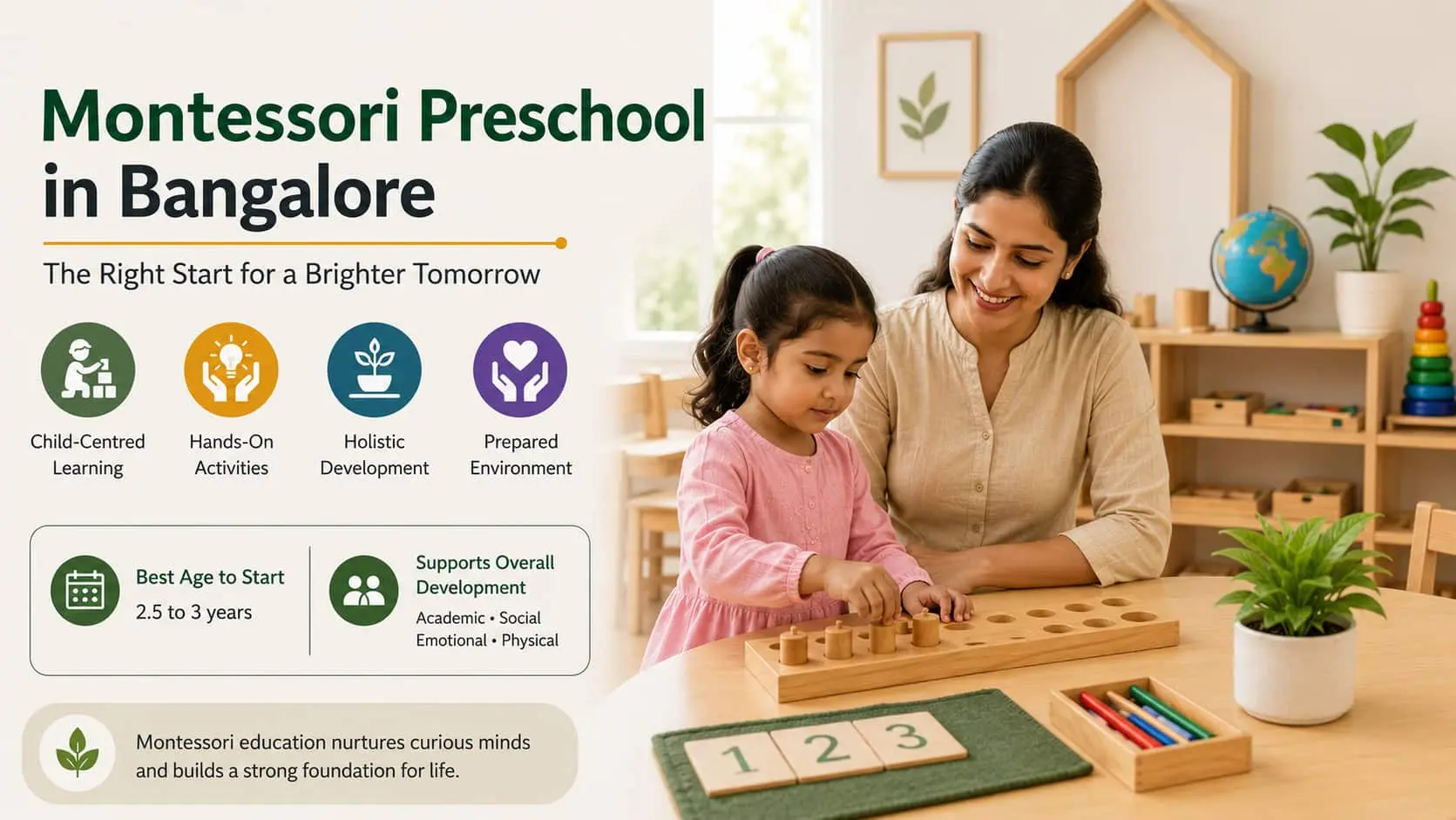
Choosing the right preschool is one of the most important decisions parents make, as it lays the foundation for their child’s learning, confidence, and overall development. A high-quality preschool not only introduces children to structured learning but also helps build confidence, independence, creativity, and essential social skills. Today, many families are choosing a Montessori preschool in Bangalore because of its child-centred approach and focus on holistic development. This guide explains what Montessori education is, the best age to start preschool, signs of preschool readiness, and how to choose the best Montessori preschool for your child.
What Is Montessori Education?
Montessori education is a child-centred learning approach that encourages independence, hands-on exploration, and self-paced learning in a carefully prepared environment.
Unlike traditional classrooms that rely mainly on teacher-led instruction, Montessori education encourages children to learn independently while supporting their academic, social, emotional, and physical development.
Montessori education is a child-centred learning approach developed by Dr. Maria Montessori. It encourages children to learn independently through hands-on activities in a carefully prepared environment. Rather than following a one-size-fits-all teaching method, Montessori classrooms allow children to explore concepts at their own pace while teachers act as guides.
This approach is built on the belief that every child is naturally curious and capable of learning when given the right environment. Children are encouraged to make choices, solve problems independently, and develop practical life skills alongside academic knowledge.
Why Montessori Education Matters During Early Childhood
The early years of a child’s life are a crucial stage of rapid brain growth and overall development. Experiences during this stage influence future learning, behaviour, and emotional well-being. This is why early childhood education plays such an important role in helping children build a strong foundation for lifelong success.
Builds Independence Through Everyday Activities
One of the key benefits of the Montessori method is its focus on helping children become confident and independent learners. Children learn practical life skills such as arranging their learning materials, pouring water, buttoning clothes, washing hands, and tidying up after activities.These simple tasks help children build confidence and independence while encouraging them to complete everyday activities on their own and become more responsible learners.
Supports Cognitive Development
Montessori classrooms are designed to stimulate curiosity and encourage children to think independently. Through carefully selected learning materials, children strengthen their concentration, improve memory, develop problem-solving abilities, and build critical thinking skills. Since each child progresses at their own pace, they gain a deeper understanding of concepts instead of simply memorising information.
Encourages Social and Emotional Growth
In a Montessori environment, children interact with classmates of different ages, creating opportunities to learn cooperation, communication, patience, and empathy. They learn to respect others, resolve conflicts peacefully, and work together on activities. These experiences contribute significantly to healthy emotional development and prepare children for future school and social environments.
Develops Creativity and Curiosity
Children naturally enjoy exploring their surroundings. Montessori classrooms encourage this curiosity by offering hands-on learning experiences instead of passive instruction. Activities involving art, nature, music, science, and practical exploration inspire creativity while helping children develop a genuine love for learning that extends beyond the classroom.
What Is the Best Age to Start Preschool?
Many parents wonder about the best age to start preschool. While every child develops at their own pace, most Montessori schools recommend enrolling children between 2.5 and 3 years of age. At this stage, children become more independent, naturally curious about the world around them, and ready to interact with other children in a structured learning environment.
Rather than focusing only on age, parents should consider their child’s developmental readiness. A child who feels secure, communicates basic needs, and enjoys exploring new activities is often ready to benefit from a Montessori classroom.
Signs Your Child Is Ready for Preschool
Every child develops at their own pace, but the following preschool readiness signs can help parents understand whether their child is prepared to begin their learning journey.
- Shows curiosity about new people, objects, and activities.
- Can stay away from parents or caregivers for a short period without significant distress.
- Enjoys playing and interacting with other children.
- Understands and follows simple instructions.
- Begins developing toilet independence.
- Expresses basic needs using words or simple communication.
- Shows interest in books, stories, songs, or creative activities.
Most children are ready to start a Montessori preschool between 2.5 and 3 years of age. Signs of readiness include curiosity, growing independence, the ability to follow simple instructions, and an interest in learning and social interaction.
Montessori Preschool vs Traditional Preschool: What's the Difference?
Many parents compare Montessori schools with traditional preschools before making an admission decision. While both aim to support early childhood education, their teaching methods, classroom environments, and learning experiences are quite different.
Montessori Preschool | Traditional Preschool |
Child-led learning | Teacher-led instruction |
Hands-on Montessori materials | Worksheets and structured lessons |
Mixed-age classrooms | Same-age classrooms |
Self-paced learning | Fixed curriculum and pace |
Focus on independence | Focus on group instruction |
Individual learning plans | Uniform learning activities |
Teachers act as guides | Teachers lead every activity |
In a Montessori classroom, children are encouraged to choose activities based on their interests while learning within a structured environment. Teachers observe, guide, and support rather than direct every lesson. This approach helps children develop confidence, independence, and a lifelong love of learning through hands-on experiences and self-directed activities.
Traditional preschools usually follow a fixed timetable where all children participate in the same activity at the same time. While this structure works well for some children, others may benefit more from the flexibility and personalised learning offered by the Montessori method.
Which approach is right for your child?
There is no single answer for every family. Understanding the differences between Montessori vs traditional preschool can help parents choose the learning environment that best matches their child’s personality and learning style.
If your child enjoys exploring independently, learning through hands-on experiences, and progressing at their own pace, a Montessori preschool in Bangalore may be an excellent choice. If your child prefers more structured teacher-led activities, a traditional preschool may also provide a positive learning experience.
What Does a Montessori Curriculum Include?
A well-designed Montessori curriculum focuses on the overall development of the child rather than academics alone. Children learn through practical experiences that build confidence, independence, and essential life skills.
Practical Life Skills
Practical life activities teach children everyday skills such as pouring water, arranging materials, cleaning up after themselves, buttoning clothes, tying shoelaces, and caring for plants. These activities improve coordination, concentration, responsibility, and self-confidence while helping children develop essential life skills for preschoolers that support learning both at school and at home.
Sensorial Learning
Montessori classrooms include specially designed materials that allow children to explore colours, textures, shapes, sounds, weights, and sizes. These activities sharpen observation skills and help children understand the world through their senses, laying a strong foundation for future academic learning.
Language Development
Children develop vocabulary, listening, speaking, reading, and writing skills through storytelling, phonics, conversations, picture cards, songs, and interactive language activities. Learning takes place naturally through daily communication and meaningful experiences.
Early Mathematics
Instead of memorising numbers, children use hands-on materials such as counting beads, number rods, and puzzles to understand mathematical concepts. This practical approach makes learning numbers, patterns, sequencing, and basic operations enjoyable and meaningful.
Cultural Studies and Nature Exploration
Children are introduced to geography, science, history, animals, plants, different cultures, and the natural world through stories, maps, experiments, gardening, and outdoor exploration. These activities encourage curiosity, respect for nature, and appreciation for diversity.
A Typical Day at a Montessori Preschool
Parents often wonder what a normal day looks like inside a Montessori classroom. Although every school follows its own schedule, most Montessori preschools provide a balanced routine that combines learning, exploration, creativity, and play.
Arrival and Welcome
Children are greeted warmly and settle into the classroom independently. This routine helps them develop confidence, responsibility, and a sense of belonging from the start of the day.
Uninterrupted Work Cycle
One of the defining features of Montessori education is the uninterrupted work period. During this time, children choose activities based on their interests while teachers observe and guide them individually. This allows children to focus deeply without unnecessary interruptions.
Individual and Small Group Learning
Teachers introduce new concepts through one-on-one or small-group lessons based on each child’s developmental stage. This personalized approach ensures that every child progresses comfortably without feeling rushed or held back.
Outdoor Play and Physical Activities
Physical fitness in preschool plays an important role in supporting healthy growth, improving coordination, strengthening motor skills, and encouraging children to stay active every day. Running, climbing, balancing, and group games improve gross motor skills, coordination, teamwork, and overall physical well-being while giving children opportunities to interact socially.
Story Time, Music and Creative Activities
Children participate in storytelling, singing, music, art, craft, and imaginative play. These activities strengthen language skills, creativity, listening ability, and self-expression while making learning enjoyable.
Snack and Social Interaction
Snack time encourages children to practise independence by serving themselves, cleaning up afterwards, and interacting respectfully with classmates. These daily routines reinforce practical life skills learned throughout the day.
Reflection and Home Time
Before leaving, children organise their materials, reflect on their activities, and prepare for home. This simple routine helps develop responsibility, organisation, and a sense of accomplishment.
Why Parents in Bangalore Prefer Montessori Preschools
As awareness of Montessori education continues to grow, more families are choosing a Montessori preschool in Bangalore because of its personalized learning approach and focus on holistic development.
Individual Attention
Montessori classrooms are designed to recognise that every child learns differently. Teachers observe each child’s interests, strengths, and developmental needs before introducing new learning experiences, allowing children to progress with confidence.
Smaller Class Sizes
Many Montessori schools maintain smaller class sizes, giving teachers more opportunities to interact with each child. This personalised attention helps children feel supported and encourages stronger relationships between teachers and students.
Safe and Child-Friendly Campuses
Parents place great importance on safety when selecting a preschool. Well-designed Montessori campuses provide secure learning environments with child-friendly classrooms, age-appropriate furniture, clean play areas, and safety measures that allow children to explore confidently.
Qualified Montessori Teachers
Experienced and trained Montessori educators understand child psychology, developmental milestones, and the Montessori philosophy. Rather than simply teaching lessons, they guide children in discovering knowledge independently while providing encouragement and support.
Modern Learning Environment
Today’s best Montessori preschools in Bangalore combine authentic Montessori materials with spacious classrooms, outdoor learning spaces, reading corners, art areas, and activity zones that encourage exploration and creativity.
Strong Parent Involvement
Successful Montessori schools view parents as partners in a child’s learning journey. Regular parent-teacher meetings, progress updates, workshops, and school events help families stay involved in their child’s growth and development, creating consistency between home and school.
How to Choose the Best Montessori Preschool in Bangalore
Choosing the right preschool involves much more than comparing fees or location. Following a detailed preschool admissions guide can help parents evaluate teaching quality, safety standards, curriculum, and the overall learning environment before making a decision. The right preschool should provide a safe, nurturing environment where children develop confidence, independence, and a genuine love for learning.
Check Montessori Teacher Certification
Qualified Montessori teachers receive specialised training in child development and the Montessori philosophy. Ask about teacher certifications, experience, and how educators support children at different developmental stages.
Visit the Campus
A personal visit gives you valuable insights into the school’s environment. Observe whether classrooms are clean, organised, spacious, and designed to encourage independent exploration. Outdoor play areas, learning materials, and safety measures are equally important.
Observe the Classroom Environment
A Montessori classroom should be calm, inviting, and child-friendly. Learning materials should be easily accessible, allowing children to make choices independently. Watch how teachers interact with students—they should guide rather than direct every activity.
Understand the Curriculum
Ask how the Montessori curriculum is implemented. A quality preschool balances practical life activities, sensorial learning, language development, mathematics, cultural studies, and creative experiences to support holistic growth.
Ask About the Child-to-Teacher Ratio
Smaller class sizes often allow teachers to provide more personalised attention. Understanding the child-to-teacher ratio helps parents evaluate whether children receive adequate guidance and support throughout the day.
Review Safety and Hygiene Standards
Safety should always be a priority. Check classroom security, visitor policies, emergency procedures, CCTV availability (if applicable), sanitation practices, and the cleanliness of classrooms and play areas.
Understand Parent Communication
Strong communication between parents and teachers creates a better learning experience. Find out how the school shares progress reports, conducts parent-teacher meetings, and keeps families informed about classroom activities.
Consider Location and Transport
Choosing a Montessori preschool in Bangalore that’s conveniently located can make daily routines easier for both parents and children. If transport services are offered, ask about vehicle safety, trained staff, and travel routes.
Questions Parents Should Ask During Preschool Admission
Before finalising admission, prepare a list of questions to help you understand the school’s approach and determine whether it aligns with your child’s needs.
Some important questions include:
- Is your curriculum based on authentic Montessori principles?
- How are children encouraged to learn independently?
- What qualifications and Montessori certifications do teachers hold?
- How is each child’s progress observed and shared with parents?
- What does a typical daily routine look like?
- What safety and hygiene measures are followed?
- How many children are assigned to each teacher?
- What outdoor play and physical activities are included?
- How does the school support children during their transition into preschool?
- How do teachers communicate with parents throughout the academic year?
Asking these questions helps parents make informed decisions while choosing the best preschool in Bangalore for their child.
Why Early Childhood Education Shapes Lifelong Learning
The first few years of life are a period of remarkable brain development. Research consistently shows that high-quality early childhood education has a lasting impact on academic achievement, emotional well-being, communication skills, and social confidence.
A Montessori environment encourages children to become independent thinkers who enjoy exploring, asking questions, and solving problems. These experiences strengthen cognitive abilities while also nurturing creativity, resilience, empathy, and self-confidence.
Children who develop positive learning habits during their preschool years often adapt more easily to primary school and continue to approach learning with curiosity and enthusiasm. By investing in quality child development during these formative years, parents help create a strong foundation for lifelong success.
Conclusion
Every child learns in their own unique way, and choosing the right preschool is an investment in their future. While academics are important, the early years should also nurture curiosity, confidence, creativity, independence, and a lifelong love for learning.
When searching for the best Montessori preschool in Bangalore, take time to visit different campuses, observe classroom interactions, speak with teachers, and understand each school’s philosophy. A nurturing Montessori environment should inspire children to explore, ask questions, solve problems, and grow at their own pace.
By selecting a preschool that values holistic development and strong partnerships with parents, you give your child the opportunity to build the skills, confidence, and enthusiasm needed for success—not only in primary school but throughout life.
Frequently Asked Questions
What is Montessori education?
Montessori education is a child-centred approach that encourages independent learning through hands-on activities in a carefully prepared environment where teachers guide rather than direct children’s learning.
What is the best age to start preschool?
Most children are ready to begin preschool between 2.5 and 3 years of age, although readiness depends on each child’s emotional, social, and developmental progress.
How do I know if my child is ready for preschool?
Signs of preschool readiness include curiosity, the ability to follow simple instructions, growing independence, interest in playing with other children, and basic communication skills.
Is Montessori better than a traditional preschool?
Both approaches have their strengths. Montessori education focuses on self-paced, hands-on learning and independence, while traditional preschools usually follow structured teacher-led lessons. The best choice depends on your child’s personality and learning style.
What does a Montessori curriculum include?
A Montessori curriculum includes practical life skills, sensorial activities, language development, mathematics, cultural studies, science, art, music, and opportunities for independent exploration.
Are Montessori teachers specially trained?
Yes. Qualified Montessori teachers complete specialised training that helps them understand child development and effectively guide children through the Montessori learning process.
How long is a Montessori preschool day?
The duration varies between schools, but many Montessori preschools offer half-day and full-day programmes with uninterrupted work cycles, outdoor play, creative activities, and rest periods where appropriate.
How do I choose the best Montessori preschool in Bangalore?
Visit the campus, observe classrooms, meet teachers, review the curriculum, evaluate safety standards, ask about class sizes, and understand how the school communicates with parents before making your decision.
What should I ask before preschool admission?
Ask about the curriculum, teacher qualifications, classroom routines, assessment methods, safety procedures, parent communication, outdoor activities, and child-to-teacher ratio.
Does Montessori prepare children for primary school?
Yes. Montessori education helps children develop independence, concentration, communication skills, problem-solving abilities, and confidence, providing a strong foundation for a smooth transition to primary school.