

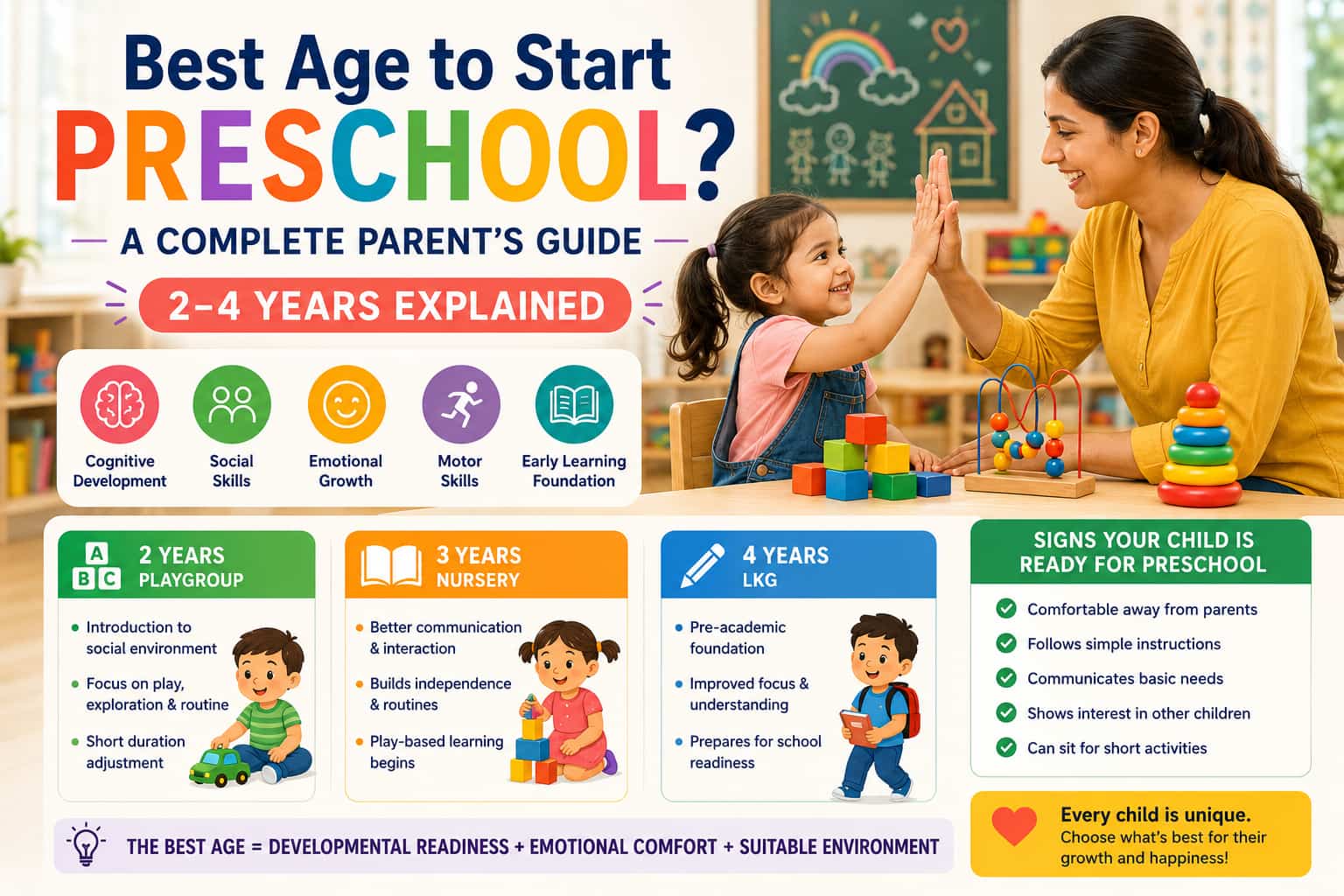
Choosing the best age to start preschool is one of the most confusing decisions for parents of toddlers. Some children start as early as 2 years, while others begin closer to 4, leaving parents unsure about what is truly right. The truth is, there is no single perfect age. This guide explains the ideal age to start preschool, readiness signs, age-wise breakdown, and expert insights so you can confidently decide what works best for your child’s development and comfort.
What Is the Best Age to Start Preschool?
The best age to start preschool is typically between 2.5 and 4 years, depending on the child’s emotional, social, and cognitive readiness. While some children adapt early at 2 years, others benefit more from starting at 3 or 4 when communication and independence are stronger.
What influences the right preschool age?
- Emotional readiness (separation from parents)
- Communication and language skills
- Ability to follow simple routines
- Social comfort with other children
Early childhood education research shows that readiness matters more than exact age. The goal of preschool education is not academic pressure but gradual development through structured play and interaction. If you’re wondering whether your toddler is prepared, understanding the preschool readiness signs can help you make the right decision.
Preschool Age in India Explained (Playgroup to UKG)
The preschool age range in India typically spans 2 to 6 years, covering Playgroup, Nursery, LKG, and UKG. Each stage supports different developmental milestones, helping children transition smoothly into formal schooling.
Common preschool structure in India:
- Playgroup (2–3 years): Introduction to social environment
- Nursery (3–4 years): Early learning and routine building
- LKG (4–5 years): Pre-academic foundation
- UKG (5–6 years): School readiness preparation
Why this structure matters
- Aligns with early childhood education standards in India
- Builds gradual academic and emotional readiness
- Reduces transition stress into Grade 1
Preschool: An early childhood education program designed for children aged 2–6 years to develop social, emotional, motor, and early cognitive skills through structured play-based learning.
2 vs 3 vs 4 Years – Which Is the Right Age for Preschool?
The right age for preschool depends on your child’s development stage. While 2-year-olds need more emotional support, 3-year-olds begin adapting socially, and 4-year-olds are usually ready for structured learning environments.
Age-wise comparison
Age | Readiness Level | Pros | Challenges |
2 years | Early exposure | Social exposure, independence start | Separation anxiety, low communication |
3 years | Balanced stage | Better communication, routine building | Still emotional dependency |
4 years | High readiness | Strong independence, learning focus | Less time in early social exposure |
Key takeaway
- 2 years: Best for gentle introduction
- 3 years: Ideal balance for most children
- 4 years: Strong academic readiness phase
Most educators agree that preschool for 3 year olds offers the most balanced development experience, especially in urban India where structured learning environments begin early.
Parents comparing different teaching approaches may also find a Parents searching for the best preschool in Bangalore should focus on curriculum quality, teacher-child ratio, and emotional development support rather than only academic reputation useful before making a decision.
Signs Your Child Is Ready for Preschool
A child’s readiness for preschool is more important than their exact age. The preschool admission age should align with emotional stability, curiosity, and basic independence rather than strict numbers.
Readiness checklist:
- Can stay away from parents for short periods
- Understands and follows simple instructions
- Communicates basic needs
- Shows interest in other children
- Can sit for short structured activities
If your child shows 3–4 of these signs, they are likely ready for toddler preschool or nursery-level entry.
Decision Guide
- If YES to most signs → Start preschool now
- If PARTIAL readiness → Consider playgroup first
- If NO → Wait 3–6 months and reassess
Benefits of Preschool Education
The advantages of preschool education extend far beyond academics. It builds the foundation for emotional intelligence, social skills, and lifelong learning habits.
Key benefits:
- Cognitive development through play-based learning
- Improved communication and vocabulary
- Social interaction with peers
- Emotional regulation and independence
Preschool also helps children develop essential life skills like teamwork, communication, and problem-solving from an early age.
Why preschool matters (2026 perspective)
Modern preschool programs follow structured play methodologies like Montessori and Reggio Emilia, focusing on holistic development instead of early academic pressure.
Research in early childhood education shows that 90% of brain development happens before age 5, making preschool a critical stage for shaping learning behavior.
When NOT to Start Preschool
Not every child is ready for preschool at the same age. Starting too early can lead to stress and resistance. For some children, beginning with playschools for children can provide a smoother transition before joining nursery.
Situations to delay preschool:
- Strong separation anxiety
- Delayed speech or communication difficulties
- Frequent emotional distress in new environments
- Inability to follow basic routines
Starting at the age to start preschool should be flexible. Delaying by a few months can significantly improve adaptation and comfort.
Preschool Admission Age in Bangalore
In cities like Bangalore, preschool admission age varies by institution, but most schools accept children starting from 2+ years in playgroup and 3+ years in nursery.
Typical admission structure:
- Playgroup: 2+ years
- Nursery: 3+ years
- LKG: 4+ years
Important notes for parents in Bangalore:
- Admission cycles often begin between October–January
- Some schools follow strict cutoff dates (June–September)
- Competitive schools may require early registration
Parents searching for the best preschool in Bangalore should focus on curriculum quality, teacher-child ratio, and emotional development support rather than only academic reputation.
How to Decide the Best Age for Your Child
The best decision comes from balancing age, readiness, and environment. There is no universal rule for the best age for preschool, but a structured approach helps parents decide confidently.
Decision framework:
- Age factor: Is your child 2–4 years old?
- Readiness factor: Emotional + communication readiness
- Environment factor: Quality of preschool setting
Simple formula:
Best Age = Developmental Readiness + Emotional Comfort + Suitable Environment
Step-by-step guide:
- Observe readiness signs
- Compare preschool options
- Start with short hours if needed
- Gradually transition to full-day preschool
Benefits vs Risks of Early vs Late Preschool Entry
Factor | Early Start (2–3 years) | Later Start (4 years) |
Social exposure | High | Moderate |
Emotional readiness | Variable | Strong |
Academic readiness | Low | High |
Adaptability | Faster long-term | Faster short-term |
The preschool age range is flexible. The best outcome depends on balancing emotional readiness with learning exposure.
Latest 2026 Trends in Preschool Learning
Modern preschool curriculum trends focus on holistic child development rather than early academics.
Key trends:
- Play-based and experiential learning
- Digital-safe early learning tools
- Montessori-inspired classrooms
- Emotional intelligence training
- Parent-school collaboration models
Top preschool programs now prioritize confidence-building and curiosity over rote learning.These are some of the key Montessori education benefits that encourage independent and lifelong learners.
Conclusion
The best age to start preschool is not a fixed number but a combination of age, readiness, and environment. While most children begin between 2.5 and 4 years, each child develops differently. Understanding emotional readiness, communication ability, and comfort level is far more important than comparing with others.
Parents should focus on gradual exposure, supportive environments, and child-led readiness rather than rushing into early admission. With the right timing, preschool becomes a joyful foundation for lifelong learning, confidence, and social growth.
FAQs
1. What is the best age to start preschool?
The best age to start preschool is generally between 2.5 and 4 years. However, the ideal time depends more on emotional and social readiness than exact age. Children who can communicate needs and separate from parents comfortably usually adapt well.
2. Is 2 years too early for preschool?
Not necessarily. Preschool for 2-year-olds is often designed as playgroup exposure. However, children at this age may experience separation anxiety, so short-duration programs are recommended instead of full-day structured learning.
3. What is the ideal preschool age in India?
In India, the ideal preschool age range is 3 to 4 years for nursery admission, with playgroup starting from 2 years. This aligns with early childhood education frameworks and developmental milestones.
4. How do I know my child is ready for preschool?
Signs include independence in small tasks, ability to follow instructions, communication of basic needs, and comfort in short separation from parents. Readiness matters more than age alone.
5. What is the difference between nursery and preschool?
Preschool is a broader term covering playgroup, nursery, and kindergarten stages. Nursery is typically the first structured learning stage for 3–4-year-olds within the preschool system.
6. Is preschool necessary for children?
While not mandatory, preschool education significantly improves social skills, emotional development, and early learning abilities, making school transition smoother and more confident.
7. What is the right age for preschool admission in Bangalore?
Most schools in Bangalore accept children from 2+ years for playgroup and 3+ years for nursery. Admission policies vary, so checking individual school requirements is important.