

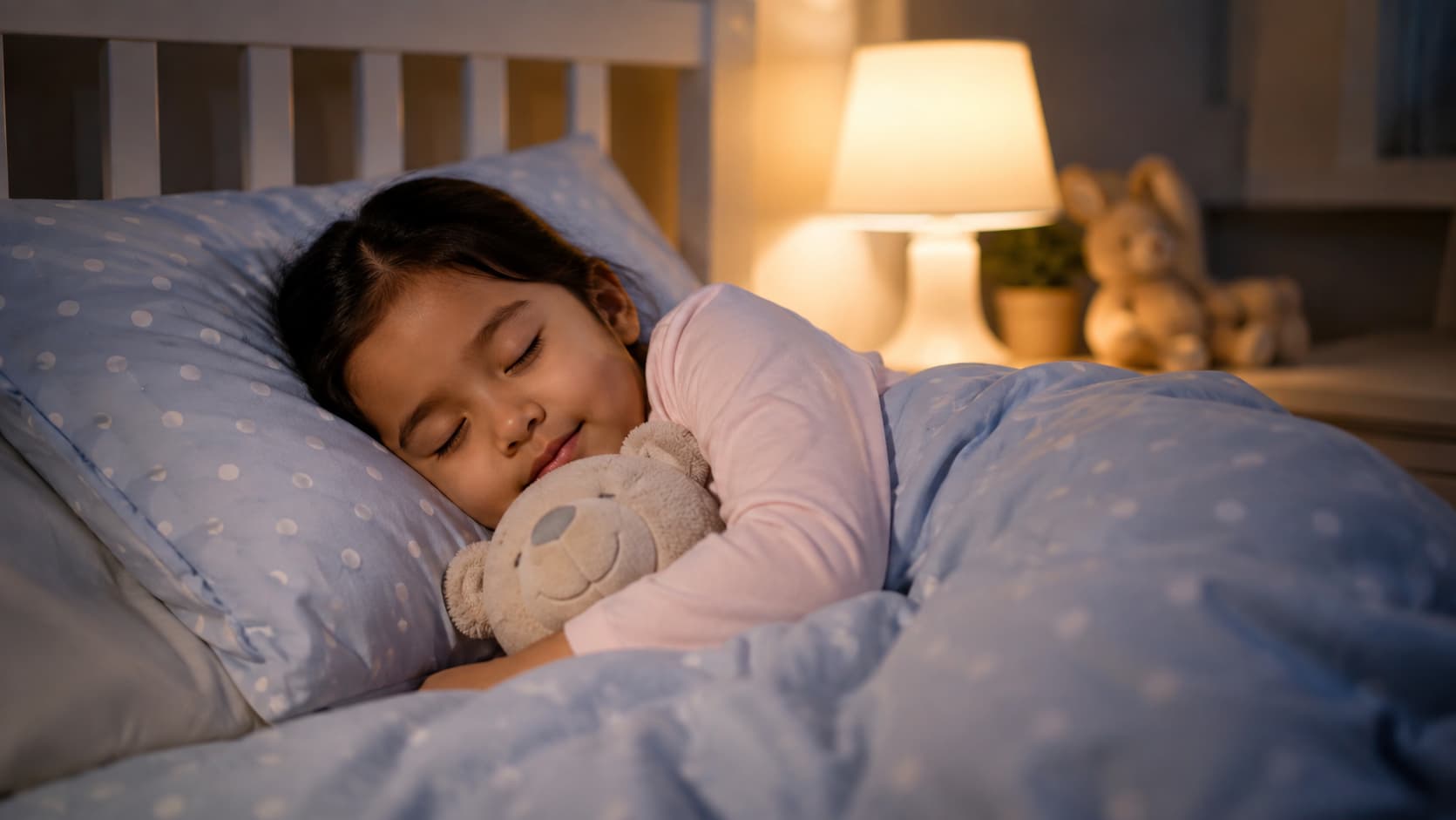
Getting a preschool child to sleep well can be harder than simply setting an early bedtime. Children between 3 and 5 years are becoming more independent, may resist bedtime, and often have busy days filled with school, play and family activities.
Healthy sleep habits for preschool children start with getting enough total sleep, keeping sleep and wake times reasonably consistent, creating a predictable bedtime routine, limiting stimulating activities and screens before bed, and watching for signs of a sleep problem. Preschoolers generally need 10 to 13 hours of sleep in a 24-hour period, including naps.
The goal is not to have a perfect schedule every night. It is a predictable pattern that gives your child enough opportunity to sleep and makes bedtime easier for the whole family.
How Many Hours of Sleep Do Preschoolers Need?
Children aged 3-5 years generally need 10-13 hours of sleep per 24 hours, including naps. This is a daily total, so a preschooler who sleeps at night and still naps should have both periods counted.
For example, a child who sleeps for 10 1⁄2 hours overnight and takes a 1-hour afternoon nap is getting about 11 1⁄2 hours in total. Another child may sleep longer at night and no longer need a regular nap. Both patterns can be reasonable because sleep needs vary between children.
What matters is looking at the whole pattern rather than judging sleep from bedtime alone. A child who is routinely getting less than 10 hours may not be getting enough sleep, while persistent daytime sleepiness, unusual irritability or difficulty functioning during the day can also be reasons to discuss sleep with a pediatrician.
As children approach kindergarten, families sometimes shift attention toward a kindergarten sleep schedule, while a consistent routine can also support child adjustment to preschool. The better approach is to work backward from the child’s required morning wake-up time and allow enough time for 10–13 hours of total sleep.
What Do Healthy Sleep Habits Look Like for Preschoolers?
Good preschool sleep habits are less about one “perfect” bedtime and more about consistency.
A healthy pattern usually includes:
- A fairly consistent wake-up time.
- A bedtime that allows enough total sleep.
- A predictable preschool bedtime routine.
- Active daytime play and outdoor time.
- A calm transition from daytime activities to sleep.
- Limited screen exposure close to bedtime.
- A bedroom that is comfortable, quiet and suitable for sleeping.
- Similar sleep expectations on school days and non-school days.
The American Academy of Pediatrics recommends regular daily routines, including consistent waking, meals, naps and bedtime. Predictability helps young children know what is coming next and can make the transition to sleep smoother.
For families in Bangalore, practical schedules may need to account for school timings, traffic, evening activities, family meals and late household routines. The important point is not to copy another family’s clock time. Build a routine that works consistently with your child’s morning obligations.
How to Create a Preschool Bedtime Routine
A good preschool sleep routine should be predictable, short enough to maintain and calming rather than stimulating.
A simple sequence might look like:
- Finish dinner and active play.
- Dim the lights and begin winding down.
- Take a bath or wash up if this is calming for your child.
- Put on pajamas.
- Brush teeth.
- Read one or two books.
- Give a brief cuddle or quiet conversation.
- Lights out at the planned bedtime.
The American Academy of Pediatrics’ “Brush, Book, Bed” approach uses the same basic idea: brush teeth, read together and go to bed at a regular time. A predictable series of steps helps children understand what comes next and reduces the need for lengthy negotiations at bedtime.
One common mistake is making the routine too complicated. If bedtime includes several games, snacks, negotiations and repeated trips out of the bedroom, the routine can unintentionally become a way of delaying sleep.
It is also useful to begin the routine before your child is overtired. Waiting until a preschooler is extremely tired can sometimes make settling down more difficult. The AAP notes that putting a young child to bed even 15–20 minutes earlier can sometimes make a meaningful difference.
How to Create a Sleep Schedule for Preschoolers
There is no universal preschool sleep schedule. A better method is to start with the morning.
Suppose a child needs to wake at 6:30 a.m. for school. If the child needs around 11 hours of total sleep and still naps for an hour, approximately 10 hours of overnight sleep would be needed. That points toward a bedtime around 8:30 p.m.
This is only an example, not a prescription. A child who does not nap may need an earlier bedtime, while another child may naturally need more or less sleep within the recommended range.
A practical schedule should consider:
| Part of the day | What to aim for |
|---|---|
| Morning | A reasonably consistent wake-up time |
| Daytime | Plenty of active play and daylight |
| Afternoon | Nap if the child still needs one |
| Evening | Gradually reduce stimulation |
| Before bed | Screen-free, predictable wind-down routine |
| Night | Consistent bedtime and a sleep-friendly environment |
For preschoolers who attend school, it is usually easier to protect the morning
wake-up time and adjust bedtime than to allow the entire schedule to drift later.
If your child sleeps much later on weekends, a large difference between weekday
and weekend timing can make Monday mornings harder. Keeping routines reasonably
similar is often more practical than trying to “catch up” with a very late morning.
Screen Time and Sleep
Screens can easily become part of a preschooler’s evening routine, so parents should understand the effects of screen time on preschoolers before bedtime. However, television, phones, tablets and other screens close to bedtime can interfere with settling down.
The AAP recommends keeping screens out of children’s bedrooms and turning them off at least one hour before bedtime.
The World Health Organization also recommends no more than one hour of sedentary screen time per day for children aged 3-4 years, with less being better, while emphasizing regular sleep and physical activity.
For parents, the practical lesson is simple: don’t make a screen the final step before sleep. Replace it with something predictable, such as reading, drawing quietly, talking about the day or listening to a calm story.
If your child currently falls asleep with the television on, removing it may initially lead to resistance. That does not necessarily mean the new routine is wrong. Introduce a consistent replacement activity rather than simply removing the familiar habit without an alternative.
Daytime Habits Also Affect Preschool Sleep
Healthy sleep is not created only at bedtime.
Preschool children benefit from regular physical fitness in preschool, including active play, outdoor activities and movement throughout the day. WHO recommends that children aged 3–4 get at least 180 minutes of physical activity spread across the day, including at least 60 minutes of moderate-to-vigorous activity.
Outdoor play, walking, running, cycling, dancing and preschool activities at home can all help children stay active during the day. Morning and daytime light exposure also helps reinforce the body’s sleep-wake rhythm.
Naps deserve individual attention. Some preschoolers still need an afternoon nap, while others naturally stop napping. If a long or very late nap consistently makes bedtime difficult, the family may need to discuss timing with the child’s pediatrician or adjust the daytime routine gradually.
The key is to look at the 24-hour sleep pattern, not assume that every preschooler needs exactly the same nap schedule.
Common Sleep Problems in Preschool Children
Bedtime resistance is common at this age, and a calm, predictable routine can help develop emotional intelligence in children while making bedtime transitions easier. A child may ask for another story, another glass of water or one more trip to the bathroom. Consistent boundaries and a predictable routine are often more useful than repeatedly changing the rules.
Other common concerns include:
- Trouble falling asleep.
- Frequent nighttime waking.
- Fear of sleeping alone.
- Bedtime stalling.
- Early morning waking.
- Nighttime fears or nightmares.
- Difficulty settling after a late nap.
- Snoring or noisy breathing.
Some problems are behavioral and improve with consistent routines. Others deserve medical attention.
Frequent snoring, breathing difficulties during sleep, significant daytime sleepiness, attention problems or behavior changes can be signs of sleep-disordered breathing such as sleep apnea. If these occur, speak with your child’s pediatrician rather than assuming the child will simply outgrow them.
A useful practical step is to keep a simple sleep log for several days. Record bedtime, approximate time asleep, nighttime waking, nap duration and morning wake-up time. This can reveal patterns that are difficult to notice from memory and can give a pediatrician useful information.
How to Establish Healthy Sleep Habits for Preschoolers
If your child’s sleep schedule is currently inconsistent, changing everything at once can create unnecessary battles.
Instead:
- Choose a realistic wake-up time. and work backward from school and family commitments while helping children develop important life skills for preschoolers through simple daily routines.
- Calculate the sleep opportunity. Aim to provide enough time for 10–13 total hours, including naps.
- Create the same bedtime sequence. Keep it simple and repeat it every night.
- Move screens earlier. Aim for at least an hour without screens before bedtime.
- Protect active daytime play. Physical activity should be part of the normal day.
- Set clear bedtime boundaries. Give limited choices, such as which pajamas to wear or which of two books to read.
- Change gradually when necessary. If bedtime is currently very late, moving it earlier in manageable steps may be easier than demanding a dramatic change overnight.
- Watch the child’s daytime behavior. Sleep quantity matters, but sleep quality matters too.
Consistency matters more than perfection. A family dinner running late or a special occasion does not undo healthy sleep habits. The objective is to return to the usual pattern afterward.
Conclusion
Healthy sleep habits for preschool children are built around enough sleep, predictable timing and a calm transition to bedtime. For most 3–5-year-olds, the target is 10–13 hours of total sleep per day, including naps.
Rather than searching for a perfect preschool sleep schedule, build a routine your family can realistically maintain. A consistent wake-up time, active daytime routine, screen-free wind-down period and simple bedtime ritual can give your child a strong foundation for healthy sleep.
If persistent snoring, breathing problems, significant daytime sleepiness or other unusual sleep difficulties are present, seek advice from a pediatrician rather than relying only on bedtime changes.
Frequently Asked Questions
How much sleep does a preschool child need?
Most children aged 3–5 years need 10–13 hours of sleep in 24 hours, including naps. Individual needs vary, so parents should also consider how the child functions during the day.
What is a good bedtime for preschoolers?
There is no single correct bedtime. Choose a bedtime that allows your child to get enough total sleep before the required morning wake-up time. A child who wakes early for school may need an earlier bedtime than a child with a later morning schedule.
Should preschoolers still take naps?
Some preschoolers still benefit from naps, while others no longer need them. Count naps as part of the child’s total daily sleep and consider whether the timing or length of a nap is interfering with nighttime sleep.
What is the best bedtime routine for preschool children?
A simple, repeatable routine works well: wash or bathe, pajamas, brush teeth, read a book, cuddle briefly and go to bed. The exact activities matter less than keeping the sequence predictable and calming.
Should a preschooler use a tablet before bed?
It is better to avoid screens close to bedtime. The AAP recommends turning screens off at least one hour before bed and keeping them out of children’s bedrooms.
How can I stop my preschooler from delaying bedtime?
Keep the routine predictable and the number of choices limited. Decide in advance how many stories, drinks or bathroom trips are part of the routine, and respond consistently rather than negotiating a new arrangement each night.
What if my preschooler snores every night?
Regular or frequent snoring should not automatically be dismissed as normal. If your child snores frequently, has breathing problems during sleep, is unusually sleepy during the day or develops attention or behavior difficulties, discuss it with a pediatrician.
What should I do if my preschooler sleeps less than 10 hours?
Look at the complete 24-hour pattern, including naps, and review bedtime, wake time, screens and daytime routines. If your child consistently gets less than the recommended amount or has daytime problems related to sleep, speak with a pediatrician.