

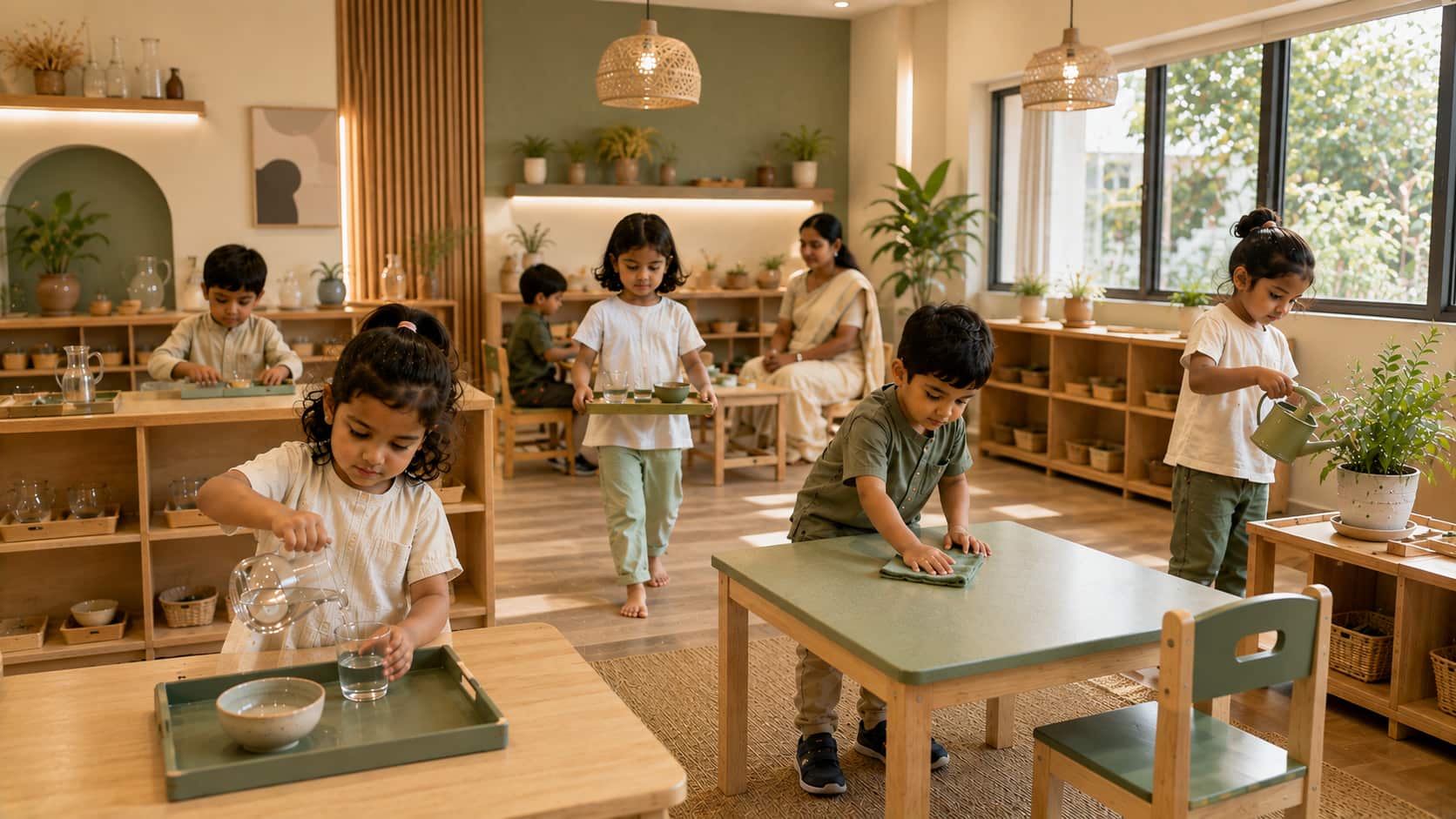
What if pouring water, washing hands, arranging a table, or putting away shoes could teach more than the task itself? That is the idea behind Montessori practical life activities. Instead of separating “learning” from everyday life, Montessori gives young children purposeful opportunities to participate in real tasks. These experiences can help children develop independence, concentration, coordination, order, confidence, and responsibility while learning how to care for themselves and their surroundings. For parents, the interesting question is not simply which activities children should do, but why ordinary tasks are such an important part of Montessori education and how to offer them meaningfully at home and preschool.
What Are Montessori Practical Life Activities?
Montessori Practical Life refers to purposeful activities based on everyday living. The Association Montessori Internationale describes Exercises of Practical Life as one of the four activity areas in the Montessori prepared environment, with activities resembling simple work children see in daily life, such as sweeping and washing dishes.
The difference is that children are not merely being asked to “help.” The environment is arranged so they can participate as independently as their age and abilities allow. A small pitcher can make pouring manageable. A low shelf can allow a child to return materials without waiting for an adult. A child-sized cloth can turn wiping a spill into something the child can actually complete.
In this sense, practical life is not a collection of chores added to the Montessori curriculum. It is a way of helping children become capable participants in their own lives.
Why Is Practical Life Important in Montessori?
Young children often want to do things for themselves long before adults are ready to let them try. They want to pour their own drink, put on their shoes, carry something, clean a spill, or help prepare food. Montessori practical life gives that desire a constructive place.
The American Montessori Society explains that Practical Life exercises in early childhood help children develop order, coordination, concentration and independence, while also providing indirect preparation for later academic work.
There is also an important developmental principle behind this approach: children learn through movement. When a child carefully carries a tray, transfers an object, washes a table or buttons clothing, the mind is not working separately from the body. The child is coordinating movement, remembering a sequence, controlling attention and working toward a meaningful result.
That is why a simple activity can sometimes hold a child’s attention surprisingly well. The task has a purpose, a beginning, a process and an end.
The Four Main Areas of Practical Life
Although Montessori programmes may organise activities somewhat differently, Practical Life in the early-childhood environment is commonly described through four broad areas: care of self, care of the environment, grace and courtesy, and control of movement. Montessori Australia uses these four areas in its Children’s House description of Practical Life.
Care of Self
These activities help children become increasingly capable of looking after their own needs. Washing hands, dressing, putting on shoes, brushing hair, managing clothing fasteners and serving food are everyday examples.
The purpose is not to make a preschooler completely independent overnight. Instead, children gradually take responsibility for parts of routines that adults previously handled for them.
Care of the Environment
Children can also learn that they have a role in looking after shared spaces. Sweeping, wiping a table, watering plants, arranging flowers, putting materials back and helping with simple cleaning are examples.
This introduces an important idea: I am not just using this environment; I can contribute to it.
The Montessori Foundation similarly describes Practical Life as including activities such as preparing food, setting the table, clearing dishes and caring for the classroom environment.
Grace and Courtesy
Practical Life is not only about physical tasks.
Children also learn how to participate respectfully in a community: greeting someone, waiting for a turn, asking for help, offering assistance, saying thank you, carrying objects carefully and resolving everyday interactions respectfully.
These behaviours are practised in real situations rather than treated only as rules to memorise. They also give children regular opportunities to express themselves, listen to others and participate respectfully, supporting the communication skills Montessori helps children develop.
Control of Movement
Many Practical Life activities require children to control how they move. Carrying a tray without dropping its contents, pouring without spilling, opening a container, transferring objects or walking carefully around furniture all require coordination.
This area is easy to overlook because the child may appear to be “just doing a task.” In reality, the child is repeatedly adjusting movement to achieve a specific purpose.
7 Benefits of Montessori Practical Life Activities
The benefits of Practical Life are interconnected. One activity can support several developmental areas at the same time.
1. Practical Life Builds Independence
Independence is probably the benefit parents notice first.
When a child learns to wash their hands, put away their belongings or prepare part of a snack, the child becomes less dependent on an adult for that particular task. More importantly, the child begins to experience themselves as capable.
Montessori Australia notes that Practical Life activities support everyday living skills while refining coordination, attention and the ability to sequence actions.
This is why the adult’s role matters so much. If an adult constantly takes over because it is faster, the child may finish the task more quickly but loses the opportunity to practise doing it.
2. It Develops Concentration
A practical activity usually has something specific to accomplish.
A child pouring water has to watch the level of the cup. A child folding a cloth has to align the edges. A child washing a table has to follow a sequence and notice whether the surface is clean.
These small challenges encourage children to focus on what they are doing.
The American Montessori Society connects the sequence and precision involved in Practical Life with the development of concentration, coordination and order.
3. It Strengthens Coordination
Practical life exercises often require both fine and gross motor control.
Turning a tap, fastening a button or using a spoon involves smaller movements. Carrying a tray, sweeping or moving a chair requires larger movements and whole-body coordination.
Because the activities have a real purpose, children have a reason to refine those movements. They are not simply practising coordination for its own sake.
4. It Builds Confidence Through Real Achievement
There is a meaningful difference between being told, “You can do it,” and actually completing something independently.
A child who pours their own water, cleans up a small spill or manages part of their dressing routine has direct evidence of growing capability.
The Montessori Foundation describes this progression as one in which small successes can contribute to children’s confidence, independence and sense of responsibility.
This does not mean every task should be easy. A useful Practical Life activity is often challenging enough to require attention but achievable enough for the child to make progress.
5. It Teaches Order and Sequencing
Many everyday tasks follow a logical sequence.
For example, washing hands involves several steps that need to happen in an appropriate order. Setting a table involves arranging several objects. Preparing a simple snack requires gathering, preparing, serving and cleaning up.
Children gradually learn that completing a task is not only about the final result. The sequence matters too.
Montessori Australia specifically identifies sequencing steps toward a goal as one of the abilities supported through Practical Life exercises.
6. It Encourages Responsibility
Responsibility becomes more meaningful when children have something real to be responsible for.
A child who waters a plant can see that the plant needs care. A child who helps put materials away can see what happens when an environment is organised. A child who carries their own plate begins to understand that participation comes with care.
These experiences can help children see themselves as contributors rather than simply recipients of adult care.
7. It Supports Social Development
Practical Life also happens in the community.
Children may prepare or serve food for others, wait while another child uses something, offer assistance, practise greetings or work together to maintain a shared environment.
The Montessori Foundation and American Montessori Society both identify grace, courtesy and cooperation as meaningful parts of early Montessori life.
So Practical Life is not only about becoming self-sufficient. It also helps children understand how their actions affect other people.
Examples of Practical Life Activities for Preschoolers
The best activities are usually connected to things children already see adults doing. They do not need to look elaborate or require expensive Montessori equipment.
For younger preschoolers, activities might include pouring water, transferring objects, wiping a small surface, washing hands, carrying a tray, opening containers, putting belongings away or watering plants.
As children become more capable, activities can become more involved. They might prepare a simple snack, set a table, fold clothing, wash dishes, arrange flowers, sweep an area, care for plants or help organise classroom materials.
These everyday experiences also contribute to essential life skills for preschoolers by helping children practise responsibility, self-care, coordination and everyday decision-making.
What Makes a Practical Life Activity Truly Montessori?
This is where parents can easily be misled. A tray containing beans, tongs and two bowls may look “Montessori,” but the presence of a Montessori-style activity does not automatically make the experience meaningful.
Authentic Practical Life has a purpose connected to real life. The child should understand, at an age-appropriate level, what the activity is for.
The American Montessori Society makes a useful distinction between traditional Practical Life work and activities that may be modified for practice. It notes that real tasks such as preparing food or caring for the environment connect the activity to practical contribution, while modified exercises can still have value when they support coordination and other foundations.
A good practical-life experience therefore asks more than, “What skill can we practise?”
It also asks, “What meaningful work can this child genuinely participate in?”
How Should Adults Present Practical Life Activities?
The adult’s approach can make a major difference.
Instead of giving a long verbal explanation, Montessori presentations generally emphasise careful demonstration. The adult prepares the materials, performs the movements deliberately and then gives the child an opportunity to try.
Once the child begins, stepping back is often harder than demonstrating the activity. Adults naturally want to correct spills, speed things up or prevent mistakes. But some of the learning happens precisely because the child has to notice what went wrong and try again. These small moments also show how Montessori encourages problem-solving skills through real, hands-on experiences.
The Montessori Foundation and Montessori educators emphasise the value of allowing children to participate in meaningful tasks and develop independence rather than having adults do everything for them.
The goal is not to leave a child struggling unnecessarily. It is to offer the right amount of help: enough to make success possible, but not so much that the adult completes the work.
Practical Life Activities at Home: Where Should Parents Start?
You do not need to buy a complete Montessori shelf to bring Practical Life into your home.
Start with something your child already wants to do. If your child insists on pouring their own water, create a safe opportunity to practise. If they want to help in the kitchen, give them an age-appropriate preparation task. If they enjoy cleaning, provide a small cloth and a manageable area.
The American Montessori Society recommends incorporating ordinary activities such as dressing, brushing teeth, sweeping, setting the table and helping prepare meals into children’s daily lives.
The most useful question is not, “How many Montessori activities can I fit into the day?” It is, “What can my child reasonably do for themselves?”
That shift makes Practical Life much easier to sustain.
Common Mistakes Parents Make With Practical Life
One common mistake is choosing activities because they look impressive rather than because they are meaningful to the child. Practical Life works best when the activity has a clear purpose and an appropriate level of challenge.
Another mistake is expecting perfection. Spilled water, crooked folding and misplaced objects are part of learning. If every mistake leads to immediate adult correction, children may become more concerned with pleasing the adult than mastering the task.
Parents can also make activities too difficult too soon. A child who is ready to pour a small amount of water may not be ready to manage a complicated food-preparation activity. Progression should follow the child, not a rigid checklist.
Safety is another essential consideration. Water, kitchen tools, food, cleaning materials, glass and other household items must be adapted to the child’s age and supervised appropriately. Montessori encourages independence, but it does not mean removing sensible safety boundaries.
How Do Practical Life Activities Support Academic Learning?
Practical Life is not intended to replace literacy, mathematics or other areas of early education. Its contribution is more foundational.
When children repeatedly practise controlled movements, sequencing, concentration, following a process and completing work independently, they are developing capacities that can support later learning.
The American Montessori Society describes Practical Life as indirect preparation for academics, pointing to relationships between activities such as table washing, movement patterns, sequencing, motor control and later academic foundations.
It is therefore more accurate to say that Practical Life supports the foundations for learning rather than claiming that sweeping a floor directly teaches reading or mathematics.
That distinction is important. Montessori is not turning every household task into an academic lesson. It is recognising that young children develop through purposeful action.
How Practical Life Fits Into Cherubs Montessori
Cherubs Montessori describes its approach as hands-on and child-centred, with children learning through exploration, age-appropriate routines and Montessori materials. Its current programme information also highlights independence, coordination, confidence, concentration and hands-on learning across its age-specific programmes.
This makes Practical Life a natural part of the broader Montessori approach rather than an isolated activity. Parents considering the school can use a campus visit to ask how children participate in everyday routines, how much independence they are encouraged to develop and how educators decide when to step in or step back.
Cherubs Montessori’s admission process includes a campus visit and child interaction as part of the enrollment journey. A visit gives parents an opportunity to see how the environment works in practice rather than judging Montessori only from descriptions or photographs.
What Should Parents Look for in a Montessori Preschool?
If Practical Life is important to your family, observe what children actually do during a school visit.
Look for an environment where children can access appropriate materials, participate in routines and contribute to the classroom rather than relying on adults for every small task. Notice whether educators give children enough time to complete activities and whether mistakes are handled calmly.
You can also ask practical questions:
- How are Practical Life activities introduced at different ages?
- Do children participate in food preparation or classroom care?
- How are children encouraged to manage their own belongings?
- How does the school balance independence with safety?
- Do teachers observe individual readiness before increasing responsibility?
The answers can tell you more about the school’s Montessori practice than a long list of activities alone.
Conclusion
Montessori practical life activities show children that learning is not limited to books, worksheets or specially designed classroom materials. Pouring water, dressing, preparing food, cleaning a surface or caring for a shared space can help a young child practise concentration, coordination, sequencing, responsibility and independence at the same time. The deeper value is the message behind these experiences: you are capable of contributing. For parents choosing a Montessori preschool, look beyond the activity list and observe whether children are genuinely trusted with meaningful, age-appropriate responsibilities. A thoughtful Montessori environment gives children the time, tools and guidance to gradually do more for themselves and to feel proud of what they can accomplish.
Frequently Asked Questions
What are Montessori Practical Life activities?
They are purposeful, everyday activities that help children practice caring for themselves, caring for their environment, controlling movement and participating respectfully in a community. Examples include dressing, washing, pouring, cleaning, food preparation and grace-and-courtesy activities.
Why are Practical Life activities important in Montessori?
They help children develop independence, concentration, coordination, order, sequencing, responsibility and confidence. They also provide indirect preparation for later academic and social learning.
What are some Practical Life activities for preschoolers?
Preschoolers can practise pouring, transferring, hand washing, dressing, folding, sweeping, wiping tables, setting the table, preparing simple food, caring for plants and returning materials to their proper places.
Can Practical Life activities be done at home?
Yes. Many Practical Life activities are simply everyday household tasks adapted to the child’s size, ability and safety needs. Parents can involve children in dressing, meal preparation, tidying, setting the table, sweeping and other manageable routines.
Do children need special Montessori materials?
No. Specialised materials can be useful in a prepared environment, but many practical-life experiences use ordinary household objects. The important factors are purpose, appropriate difficulty, accessibility and safety.
At what age should children start Practical Life?
Practical Life begins very early in Montessori environments and changes as children develop. Montessori Australia describes fundamental life skills for toddlers and then builds toward increasingly complex Practical Life experiences in the 3–6 environment.