

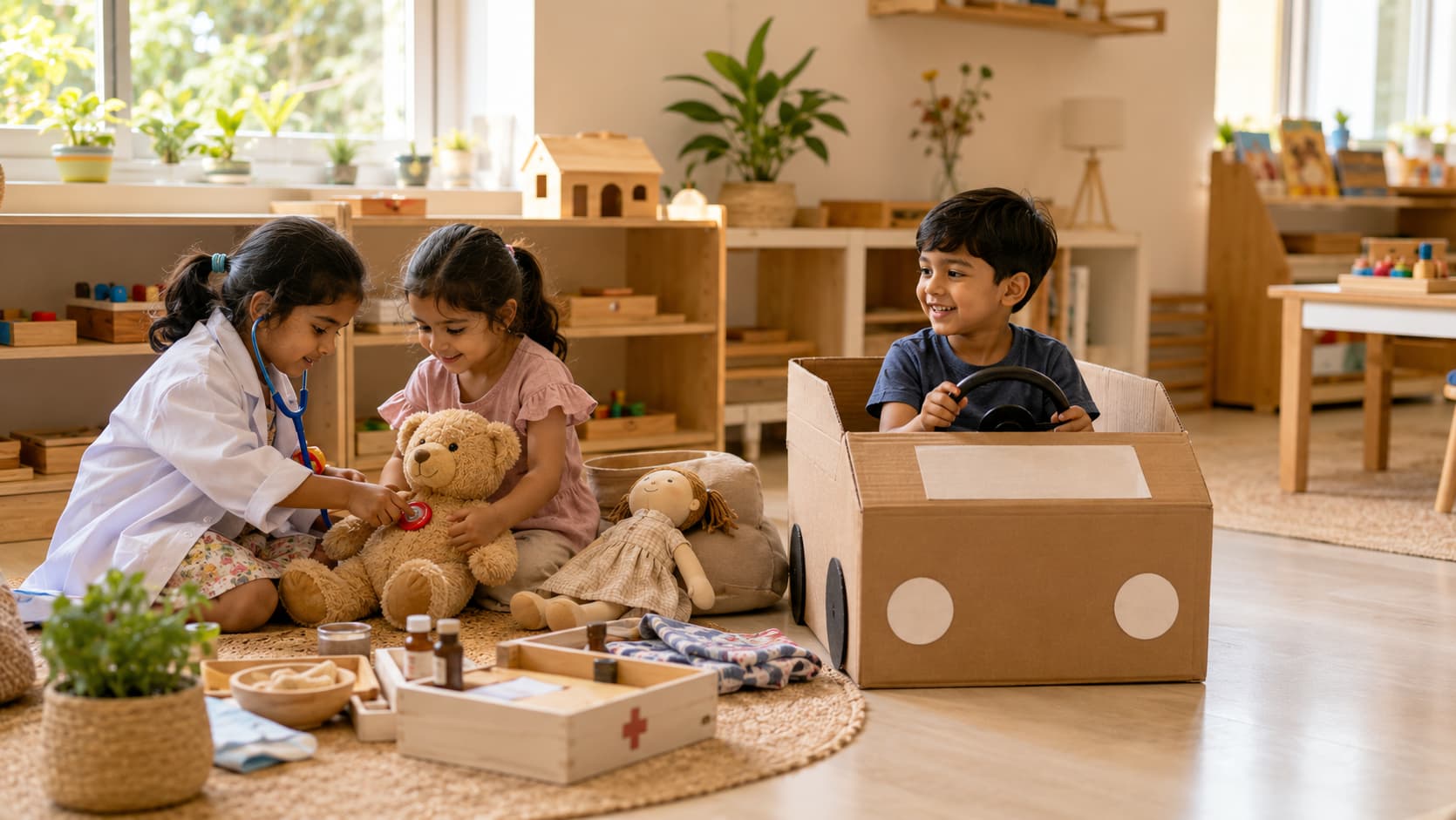
A cardboard box becomes a bus. A spoon becomes a microphone. A teddy bear becomes a patient. To a child, it is play but behind these simple moments are opportunities to imagine, communicate, solve problems and understand the world around them.
The benefits of pretend play for preschoolers go far beyond keeping children entertained. From supporting creativity and language development to encouraging social skills and emotional expression, pretend play in early childhood can be a meaningful part of development.
But what does research actually say, and how can parents make the most of imaginative play for preschoolers? Let’s explore.
What Is Pretend Play?
Pretend play, also called imaginative, make-believe or dramatic play, happens when children act “as if” something is different from reality.
A child might:
- Pretend to cook a meal
- Play doctor with a stuffed animal
- Turn a chair into a bus
- Pretend to run a shop
- Dress up as a teacher or firefighter
- Create a house from cushions
- Use blocks to build a city
- Act out a story from a book
- Give an imaginary friend a personality
- Pretend that a spoon is a telephone
The important part is not the toy itself. It is what the child does with the idea.
Pretend play asks children to represent one thing as another, create scenarios, assign roles and often develop rules for their imaginary world. NAEYC gives a simple example of this symbolic thinking through playdough: a child may transform a piece of dough into a cake, animal or other object through imagination.
This is why an expensive toy is not necessary. A box, cloth, wooden spoon or collection of everyday household objects can provide plenty of opportunities for imaginative play.
7 Important Benefits of Pretend Play for Preschoolers
Pretend play is valuable because several developmental skills can be practised at the same time.
1. Pretend Play Encourages Creativity and Imagination
One of the most obvious benefits of pretend play is that children get to create possibilities rather than simply follow instructions.
When a child turns a cardboard box into a train, there is no single correct answer. They decide:
- What the box represents
- Where the train is going
- Who is travelling
- What happens during the journey
- How the problem will be solved if something goes wrong
This open-ended quality gives children room to generate ideas and experiment with different possibilities.
Research on pretend play and creativity is nuanced, so it would be too strong to say that pretend play automatically makes a child more creative. However, imaginative play involves several processes associated with creative thinking, including transforming objects, developing stories and generating ideas.
Try this: Give your child a few simple objects and ask, “What could these become?” Rather than showing them what to make, let them decide.
2. Pretend Play Supports Language and Communication
Listen closely when children play pretend and you may hear surprisingly detailed conversations.
A child playing “restaurant” may need to:
- Welcome a customer
- Take an order
- Ask questions
- Name food
- Explain what is available
- Negotiate roles
- Tell someone what to do next
The imaginary situation gives language a purpose.
Research involving preschoolers has found relationships between aspects of pretend play and language competence, including linguistic complexity. One longitudinal study also found that one measure of pretend play predicted later receptive vocabulary, although the researchers caution that the relationship is complex.
UNICEF India similarly recommends pretend play, storytelling and conversation as ways parents can create learning opportunities for preschool-aged children.
This makes pretend play particularly useful for children who enjoy talking, storytelling and role-playing. For more ideas on supporting communication, explore communication skills in children through Montessori learning.
Try this: Instead of asking only, “What are you doing?”, ask open-ended questions such as:
- “Where are you going?”
- “What happened next?”
- “Who is coming to your shop?”
- “How can we help the teddy?”
- “What do we need to take with us?”
These questions invite the child to use more language without turning play into a lesson.
3. Pretend Play Gives Children Opportunities to Practise Social Skills
Pretend play becomes especially interesting when two or more children play together.
Suppose one child wants to be the doctor and another wants the same role. They now have a social problem to solve.
They might negotiate:
“You can be the doctor first, then I’ll be the doctor.”
Or they may decide that there are two doctors.
These small interactions provide opportunities to practise:
- Taking turns
- Sharing roles
- Listening
- Negotiating
- Cooperating
- Following agreed rules
- Resolving disagreements
A 2024 meta-analysis covering 34 empirical studies found a positive relationship between pretend play and social competence in early childhood. Interestingly, the quality of pretend play appeared more important than simply how much pretend play children did.
However, newer research also shows why parents should avoid making absolute claims. A 2026 controlled intervention study did not find significant effects of an eight-week pretend-play intervention on all measured social-cognitive and social-emotional outcomes.
The practical takeaway is simple: pretend play creates useful opportunities to practise social behaviour, but it is one part of a child’s broader social development.
4. Pretend Play Helps Children Explore Feelings and Different Perspectives
Children often use play to recreate situations they have experienced.
A child who has recently visited a doctor may examine a teddy bear. A child preparing to start preschool may pretend to be a teacher. Another child might put a doll to bed and repeat the words they hear at home.
Through these scenarios, children can experiment with different roles and emotions while developing a better understanding of feelings. Parents can also learn more about emotional intelligence in children and how early education can support it.
The American Academy of Pediatrics notes that preschoolers’ fantasy play can give them ways to explore emotions, identities and situations that matter to them.
Pretending to be someone else can also encourage children to think about what another character might want or feel. This does not mean every pretend-play episode automatically develops empathy, but it creates a natural setting in which children can practise considering another perspective.
Try this: If your child says, “The teddy is scared,” rather than immediately solving the problem, ask, “What do you think will help Teddy feel safe?”
Let your child decide the answer.
5. Pretend Play Encourages Flexible Thinking and Self-Regulation
Pretend play can become surprisingly complicated.
A child may have to remember the role they are playing, follow the rules of the imaginary situation, switch roles, wait for another child and adapt when the story changes.
These demands overlap with aspects of executive functioning such as working memory, cognitive flexibility and self-regulation. Parents can also explore more problem-solving activities for children that encourage independent thinking.
A 2026 meta-analysis of 26 studies involving 2,915 children aged 12–72 months found a significant relationship between pretend play and executive functions, although the effect was small and the evidence was correlational rather than proof of cause and effect.
This is a useful distinction for parents. Pretend play should not be viewed as a guaranteed “brain training” exercise. Instead, it is one enjoyable context in which children may practise flexible thinking and self-management.
Try this: Let your child create a pretend game with a few simple rules. After they become comfortable, introduce a small change:
“The shop is closed today. What could we do instead?”
See what solution they invent.
6. Pretend Play Can Help Children Make Sense of Everyday Experiences
Children do not always have the vocabulary to explain everything they experience.
Play can give them another way to process familiar events.
For example, a child who is about to start preschool might repeatedly play:
- Going to school
- Saying goodbye to a parent
- Meeting a teacher
- Sitting with other children
- Coming home
Rather than assuming that every pretend scenario represents an emotional problem, parents can simply recognise play as one way children explore their experiences.
This is particularly useful because pretend play allows the child to control the situation. They can change the story, repeat it or decide what happens next.
The American Academy of Pediatrics specifically notes that children may use imaginative scenarios to explore experiences and emotions, while recommending that adults avoid taking over the fantasy world.
7. Pretend Play Builds Confidence Through Choice and Independence
In pretend play, children frequently become the decision-makers.
They decide:
- What the story is about
- Which role they want
- What an object represents
- What happens next
- How a problem should be solved
That sense of ownership matters.
A parent might see an old bedsheet as a bedsheet. A child might see it as a tent, superhero cape, hospital blanket or spaceship wall.
When adults allow children to lead the play rather than constantly correcting or directing it, children get more opportunities to make choices and express their own ideas.
This fits naturally with a child-centred learning environment. At Cherubs Montessori, children are offered age-specific Montessori experiences that include opportunities to choose activities, explore hands-on materials and build independence and confidence.
How Pretend Play Supports Different Areas of Child Development
The benefits are easier to understand when you look at how one play scenario can involve several skills at once.
| Area of development | What children may practise through pretend play |
|---|---|
| Creativity | Creating characters, stories and new uses for objects |
| Language | Naming, describing, questioning and storytelling |
| Social skills | Sharing roles, cooperating and negotiating |
| Emotional development | Exploring feelings and familiar experiences |
| Thinking skills | Remembering rules, planning and adapting |
| Independence | Making choices and directing play |
| Confidence | Expressing ideas and taking on different roles |
The key word is practise. Pretend play does not guarantee a particular developmental outcome. Children’s development is influenced by many factors, including relationships, temperament, opportunities to learn and the broader environment.
That balanced view is important because research reviews have cautioned against treating pretend play as a uniquely powerful cause of every positive developmental outcome.
Pretend Play Ideas for Preschoolers
You do not need to buy a complete pretend-play set. Start with familiar experiences and simple materials, or explore more preschool activities to try at home for simple learning ideas.
1. Pretend Grocery Store
Turn a small area of your home into a pretend grocery store using empty food containers, a basket and some paper. Your child can arrange the products, create prices, make a shopping list and take turns being the customer and shopkeeper. Counting pretend items also adds a simple learning element to the game.
2. Doctor's Clinic
A teddy bear or doll can become the patient in a pretend doctor’s clinic. Your child can examine the patient, ask what is wrong, give simple instructions, write a pretend prescription and explain how the patient should rest. This type of play encourages communication while allowing children to explore familiar experiences.
3. Pretend Restaurant
Create a simple menu using paper and let your child decide what the restaurant will serve. They can choose who will cook, take orders and serve the food. You can also introduce small changes, such as a customer changing an order, and let your child decide how to handle the situation.
4. Bus or Train Journey
Arrange a few chairs in rows to create a pretend bus or train. Add simple tickets, bags and imaginary destinations to make the journey more engaging. As your child decides where to travel and who the passengers are, the activity can naturally encourage storytelling, conversation and imaginative thinking.
5. Puppet Story
Socks, paper bags or soft toys can easily become characters in a puppet story. Instead of giving your child a complete storyline, provide a simple starting point such as, “Two animals found a mysterious box. What was inside?” Let your child decide what happens next and develop the story in their own way.
6. Home or Family Play
Children often recreate familiar experiences through pretend play, such as cooking, cleaning, putting a baby to sleep or going to work. Rather than correcting their version of these everyday activities, watch and listen to their ideas. Following their lead gives them more freedom to express themselves and develop their own imaginary stories.
Simple, everyday materials can be enough to encourage meaningful pretend play for preschoolers. The goal is not to create a perfect play setup, but to give children the freedom to imagine, communicate and explore.
How Parents Can Encourage Imaginative Play Without Taking Over
One common mistake parents make is directing pretend play too much. Instead of deciding the roles, rules and story for your child, give them space to lead.
Rather than saying, “Let’s play restaurant. You are the waiter and I am the customer,” try saying, “I’m hungry. I wonder what restaurant you’ve created.”
Then pause and let your child take the lead. They may create a completely different story or role that you had not expected. This simple approach encourages imaginative play for preschoolers while giving children opportunities to make choices, communicate their ideas and build confidence.
Give them open-ended materials
A few scarves, boxes, containers, blocks, dolls, toy animals, paper and crayons can inspire more flexible play than toys with only one intended use.
The American Academy of Pediatrics notes that inexpensive everyday materials can provide rich opportunities for imaginative and creative play.
Follow their ideas
If your child says a cardboard box is an aeroplane, it is an aeroplane.
You do not need to make the game more sophisticated.
Ask questions instead of giving answers
Try:
- “What should we do now?”
- “Who lives here?”
- “What happened?”
- “How can we fix it?”
- “Where should we go next?”
Allow repetition
Children may play the same scenario repeatedly.
That is not necessarily a sign that they have run out of ideas. Repetition allows them to revisit familiar experiences while changing small details.
Give them uninterrupted time
Pretend play can take time to develop. If adults constantly introduce new instructions, children have less opportunity to construct their own ideas.
Should Parents Buy Special Pretend-Play Toys?
Not necessarily.
A good pretend-play environment does not need to be expensive.
Consider materials such as:
- Cardboard boxes
- Old scarves or fabric
- Safe kitchen utensils
- Paper and crayons
- Blocks
- Dolls or soft toys
- Toy animals
- Hats and simple dress-up clothes
- Empty, clean food containers
The goal is not to create a miniature version of every real-world environment. It is to give children enough material to create their own version.
For younger children, realistic objects can make pretend play easier to begin. As children become more capable of creating elaborate imaginary worlds, simple open-ended materials can support increasingly complex scenarios.
How Pretend Play Changes as Children Grow
Pretend play does not look the same at every age.
Around 18 months–2 years
Children may imitate familiar actions:
- Feeding a doll
- Pretending to drink from a cup
- Putting a toy to sleep
- Talking on a pretend phone
Around 2–3 years
Pretend scenarios often become more recognizable.
Children may imitate adults, recreate household routines and begin assigning simple roles.
Around 3–4 years
Stories can become longer and more imaginative.
Children may create characters, use objects symbolically and involve other children in their games.
Around 4–6 years
Pretend play may involve multiple characters, more elaborate rules, longer stories and more complex cooperation.
There is considerable individual variation, however. Children do not all develop pretend play in exactly the same way or at exactly the same age. Research from India has also examined how pretend-play behaviours differ across preschool age groups and between free and structured play situations.
Is Pretend Play Better Than Structured Learning?
It is not really an either-or choice.
Children benefit from a combination of experiences.
Structured activities can introduce specific concepts and skills. Open-ended play gives children opportunities to make choices, apply ideas, communicate and explore.
A well-designed early childhood environment can make room for both.
For example, a child might learn about numbers through a guided activity and later use those ideas naturally while playing “shop.” They might hear a story during group time and then recreate it with puppets.
This is one reason play remains valuable even in an education-focused environment. Parents can also explore how fun-based learning can support young children’s development.
At Cherubs Montessori, hands-on learning, storytelling, real-world activities and child-centred exploration form part of the Montessori approach described across its programmes.
What Parents Should Not Expect From Pretend Play
Pretend play is valuable, but it should not become a checklist.
A child does not need to:
- Pretend every day
- Enjoy dressing up
- Create elaborate fantasy worlds
- Always play cooperatively
- Show every supposed benefit of pretend play
Children have different personalities and play preferences.
Some children prefer building. Others prefer drawing, movement, sensory activities, books or practical tasks. Pretend play is one important form of play, not a test of whether a child is developing “correctly.”
And if you are concerned about your child’s communication, behaviour, social interaction or development, pretend play should not be used as a substitute for professional developmental guidance.
Why Pretend Play Matters in Early Childhood
Pretend play is more than entertainment—it gives children a natural way to practise language, creativity, cooperation, problem-solving and emotional expression. A restaurant game can build communication, while caring for a toy animal can help children explore familiar experiences and feelings.
The benefits of pretend play for preschoolers become stronger when children have time, simple materials and the freedom to lead their own play. It is one valuable part of a child’s overall development, not a substitute for every other learning experience.
For parents in Bengaluru, look for preschools that encourage children to explore, communicate, make choices and learn through meaningful experiences. At Cherubs Montessori, children aged 18 months to 6 years learn through a child-centred Montessori approach designed to support independence, confidence and development.