

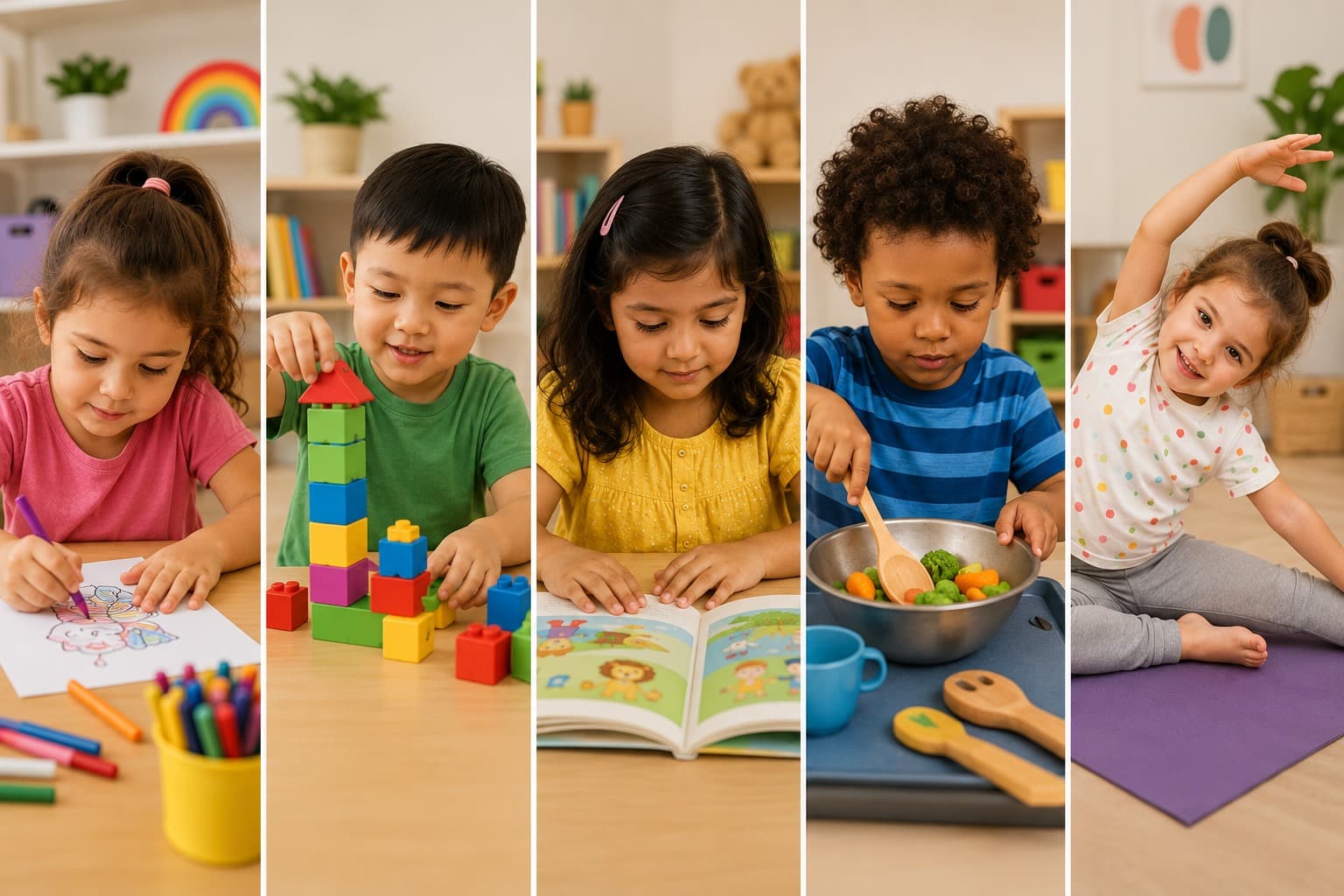
When preschoolers are stuck indoors because of rain, hot weather, pollution, or busy schedules, many parents quickly run out of ideas. It’s easy to hand over a mobile phone or switch on the television, but screen time rarely provides the hands-on experiences young children need to develop essential skills.
The good news is that some of the best indoor activities for preschoolers require little more than everyday household items, a bit of imagination, and a willingness to explore. Whether you’re a parent, caregiver, preschool teacher, or homeschooling family, the right activities can build creativity, language, problem-solving abilities, coordination, confidence, and independence.
In India, indoor play becomes especially important during monsoon months, summer heatwaves, and in apartment living where outdoor space may be limited.The most effective activities combine fun with learning, allowing children to develop naturally through play rather than formal instruction. This play-based approach is one reason why fun-based learning helps young children grow faster.
In this guide, you’ll discover 25 screen-free indoor activities organised by developmental benefits. Each activity includes practical ideas, skills developed, and why it matters for early childhood learning.
What Are Indoor Activities for Preschoolers?
Indoor activities for preschoolers are play-based experiences designed for children aged 2–5 years that can be done safely inside the home, classroom, or daycare setting. These activities may involve storytelling, creative arts, movement games, sensory exploration, puzzles, building projects, and hands-on learning experiences.
The best indoor activities for preschoolers do more than keep children busy. They strengthen cognitive development, language development, fine motor skills, gross motor skills, social skills, and creativity while encouraging curiosity and independent learning.
How Indoor Activities Support Child Development
Cognitive Development
Activities involving matching, sorting, puzzles, sequencing, and building help children recognise patterns and solve problems. For example, when a child sorts coloured buttons into different bowls, they learn classification skills that later support mathematics.
Language Development
Storytelling, conversations, puppet play, and reading activities expose children to new vocabulary and sentence structures. These experiences strengthen communication skills and prepare children for literacy.
Fine Motor Skills
Small hand movements are essential for future writing, drawing, and self-care tasks. These practical abilities are closely connected to the essential life skills preschoolers need to learn early.
Activities such as threading beads, using clothespins, and manipulating play dough strengthen finger muscles and improve hand-eye coordination.
Gross Motor Skills
Running, balancing, jumping, crawling, and dancing help children develop body awareness, balance, coordination, and confidence in movement.
Social and Emotional Development
Pretend play, cooperative games, and role-playing teach sharing, turn-taking, empathy, and emotional expression. These skills are critical for school readiness and healthy relationships. They also play a major role in helping children develop confidence and independence from an early age.
Quick Skill Guide
Activity | Age | Skill Developed | Setup Time |
Story Basket | 2–5 | Language | 5 min |
Pretend Play Box | 2–5 | Creativity | 5 min |
Puppet Theatre | 3–5 | Communication | 10 min |
Drawing Challenge | 3–5 | Creativity | 2 min |
Mini City Building | 4–5 | Problem Solving | 10 min |
Colour Sorting | 2–4 | Cognitive Skills | 5 min |
Number Hunt | 3–5 | Numeracy | 5 min |
Alphabet Match | 3–5 | Literacy | 10 min |
Shape Detective | 2–5 | Observation | 5 min |
STEM Building | 4–5 | Logical Thinking | 10 min |
Pom-Pom Transfer | 2–4 | Fine Motor | 5 min |
Bead Threading | 3–5 | Coordination | 5 min |
Sticker Activity | 2–4 | Pre-writing | 2 min |
Clothespin Sorting | 3–5 | Hand Strength | 5 min |
Play Dough Letters | 3–5 | Literacy | 5 min |
Creative Indoor Activities for Preschoolers
1. Story Basket Adventures
Fill a basket with random objects such as a spoon, toy animal, scarf, and block. Ask your child to create a story using all items.
Skills Developed: Language development, creativity, sequencing, vocabulary.
Why It Matters: Children learn to organise ideas and express themselves confidently, supporting the same confidence-building skills encouraged in Montessori environments.
2. Cardboard Box Pretend Play
Turn a delivery box into a bus, rocket, shop, or house.
Skills Developed: Imaginative play, social skills, creativity.
Why It Matters: Pretend play encourages flexible thinking and problem-solving.
3. DIY Puppet Theatre
Use socks or paper bags to create puppets.
Skills Developed: Communication, storytelling, emotional expression.
Why It Matters: Children often express thoughts through characters more easily than direct conversation.
4. Drawing Prompt Challenge
Give prompts such as “Draw a purple elephant having tea.”
Skills Developed: Creative thinking, fine motor control.
Why It Matters: Open-ended drawing encourages originality rather than copying.
5. Build a Mini City
Use blocks, cups, or cardboard to build roads and buildings.
Skills Developed: Planning, spatial awareness, STEM thinking.
Why It Matters: Children learn how structures fit together and solve construction challenges.
Educational Activities for Preschoolers
6. Colour Sorting Game
Sort buttons, toys, or paper pieces by colour.
Skills Developed: Classification, observation.
Why It Matters: Sorting forms the foundation of early maths skills.
7.Number Treasure Hunt
Hide number cards around the room.
Skills Developed: Number recognition, memory.
Why It Matters: Movement combined with learning improves retention.
8. Matching CardsAlphabet
Match uppercase and lowercase letters.
Skills Developed: Literacy readiness, letter recognition.
Why It Matters: Early exposure to letters supports future reading skills.
9.Shape Detective
Search for circles, squares, and triangles around the house.
Skills Developed: Observation, geometry awareness.
Why It Matters: Children begin recognising shapes in real-world settings.
10. Simple STEM Building Challenge
Challenge children to build the tallest tower using paper cups.
Skills Developed: Engineering thinking, experimentation.
Why It Matters: Failure and rebuilding teach resilience and critical thinking.
Fine Motor Skill Activities
11. Pom-Pom Transfer Activity
Transfer pom-poms between bowls using spoons or tongs.
Skills Developed: Hand-eye coordination.
12. Bead Threading
Thread large beads onto string.
Skills Developed: Finger control, concentration.
13. Sticker Placement Challenge
Place stickers on drawn shapes.
Skills Developed: Precision, pre-writing skills.
14. Clothespin Sorting Game
Attach clothespins to matching coloured cards.
Skills Developed: Grip strength.
15. Play Dough Letter Making
Create letters and shapes using homemade play dough.
Skills Developed: Fine motor strength, literacy awareness.
Gross Motor Activities for Indoor Play
16. Indoor Obstacle Course
Use cushions, chairs, and masking tape pathways.
Skills Developed: Balance, coordination, confidence.
17. Animal Movement Game
Hop like a frog, crawl like a bear, or waddle like a duck.
Skills Developed: Body awareness and coordination.
18. Balloon Volleyball
Use a balloon instead of a ball.
Skills Developed: Tracking skills and reaction time.
19. Dance and Freeze Game
Play music and freeze when it stops.
Skills Developed: Listening skills and self-control.
20. Pillow Stepping Stones
Jump between pillows without touching the floor.
Skills Developed: Balance and planning.
Sensory Play Activities
21. Rice Sensory Bin
Fill a container with rice and hidden objects.
Skills Developed: Sensory exploration and concentration.
22. Water Transfer Station
Move water between cups using spoons and funnels.
Skills Developed: Coordination and practical life skills.
23. Texture Discovery Tray
Create a tray with cotton, sandpaper, fabric, and leaves.
Skills Developed: Sensory awareness and descriptive language.
Independent Learning Activities
24. Busy Basket Exploration
Prepare baskets containing safe open-ended materials.
Skills Developed: Independent learning and decision-making, both of which are key outcomes of Montessori education and support children’s growing confidence and self-reliance.
25. Puzzle and Problem-Solving Station
Create a dedicated area with age-appropriate puzzles.
Skills Developed: Concentration and logical thinking.
Activity-to-Development Outcome Framework
Activity | Skill Built | Development Outcome | School Readiness Benefit |
Story Baske | Vocabulary | Language Growth | Reading Readiness |
Colour Sorting | Categorisation | Logical Thinking | Maths Readiness |
Bead Threading | Fine Motor Control | Pencil Grip | Writing Readiness |
Obstacle Course | Coordination | Physical Confidence | Participation |
Puppet Theatre | Communication | Social Skills | Classroom Interaction |
STEM Building | Problem Solving | Critical Thinking | Learning Confidence |
Best Indoor Activities by Age Group
Activities for 2–3 Year Olds
- Colour sorting
- Texture trays
- Story baskets
- Pom-pom transfer
- Water transfer
Focus on exploration rather than rules.
Activities for 3–4 Year Olds
- Puppet theatre
- Alphabet matching
- Sticker challenges
- Dance and freeze
Children at this stage enjoy simple instructions and imaginative play.
Activities for 4–5 Year Olds
- STEM building challenges
- Mini city construction
- Puzzle stations
- Number treasure hunts
Older preschoolers benefit from more complex problem-solving tasks.
Indoor Activities for Small Apartments and Monsoon Days in India
Many Indian families live in apartments where space is limited. Fortunately, several activities work well in compact homes.
Small-Space Activities
- Story baskets
- Puppet shows
- Sticker activities
- Colour sorting
Low-Cost Household Activities
- Plastic containers for sorting
- Old newspapers for crafts
- Kitchen utensils for pretend play
- Cardboard packaging for construction
Monsoon-Friendly Ideas
- Indoor obstacle courses
- Rice sensory bins
- Drawing challenges
- Dance games
Activities for Siblings
- Puppet performances
- Balloon volleyball
- Building projects
- Shape detective hunts
Screen-Free Activities vs Screen-Based Learning
Factor | Screen-Free Play | Screen-Based Learning |
Creativity | Child creates content | Child consumes content |
Social Skills | Encourages interaction | Often solitary |
Motor Skills | Active hand and body movement | Limited movement |
Attention Span | Longer engagement through exploration | Can encourage passive attention |
Problem Solving | Real-world experimentation | Usually guided responses |
Both approaches have value, but preschoolers generally benefit most when hands-on play forms the foundation of learning. Parents should also understand the long-term effects of screen time on preschoolers when creating a balanced routine.
Common Mistakes Parents Make with Indoor Activities
Choosing Activities That Are Too Advanced
A three-year-old may become frustrated with complex puzzles designed for older children.
Over-Structuring Play
Children often learn more when they can adapt activities in their own way.
Focusing Only on Academic Skills
Movement, creativity, and social development are equally important.
Providing Too Much Help
Allow children to struggle productively before stepping in.
Ignoring Physical Activity
Young children need regular movement breaks, even indoors.
Expert Recommendations for Meaningful Indoor Play
What Preschool Teachers Recommend
Focus on activities that allow children to explore rather than simply follow instructions.
Occupational Therapist Advice
Prioritise activities involving pinching, squeezing, threading, and grasping to strengthen hands for future writing.
Research on Play-Based Learning
Studies consistently show that children learn concepts more effectively when they actively engage with materials rather than passively receive information.
Create a Balanced Weekly Routine
Aim to include:
- 2 creative activities
- 2 movement activities
- 2 sensory activities
- 2 literacy activities
- Daily free play
This variety supports whole-child development.
Conclusion
The best indoor activities for preschoolers don’t require expensive toys, elaborate planning, or constant adult involvement. A cardboard box can become a rocket ship. A bowl of rice can become a sensory adventure. A simple story basket can spark conversations that build language skills for years to come.
When choosing educational activities for preschoolers, focus on variety rather than perfection. Include opportunities for movement, creativity, sensory exploration, independent learning, and social interaction. Over time, these everyday experiences contribute to cognitive development, confidence, problem-solving abilities, and school readiness.
Most importantly, remember that young children learn best through play. The goal isn’t to recreate a classroom at home—it’s to create opportunities for curiosity, exploration, and joyful learning every day.
Frequently Asked Questions
What are the best indoor activities for preschoolers?
Story baskets, sensory bins, obstacle courses, pretend play, and simple STEM challenges are among the most effective because they combine fun with developmental benefits.
How do indoor activities support child development?
They provide opportunities to practise communication, problem-solving, movement, creativity, and social interaction in age-appropriate ways.
What are good screen-free activities for kids?
Drawing, storytelling, puzzles, sensory play, building projects, dance games, and pretend play are excellent screen-free options.
Which indoor activities improve fine motor skills?
Bead threading, clothespin sorting, pom-pom transfer activities, sticker placement, and play dough modelling strengthen the small muscles needed for writing.
How can I keep my preschooler busy indoors?
Rotate activities regularly, create themed activity baskets, and provide open-ended materials that encourage independent exploration.