

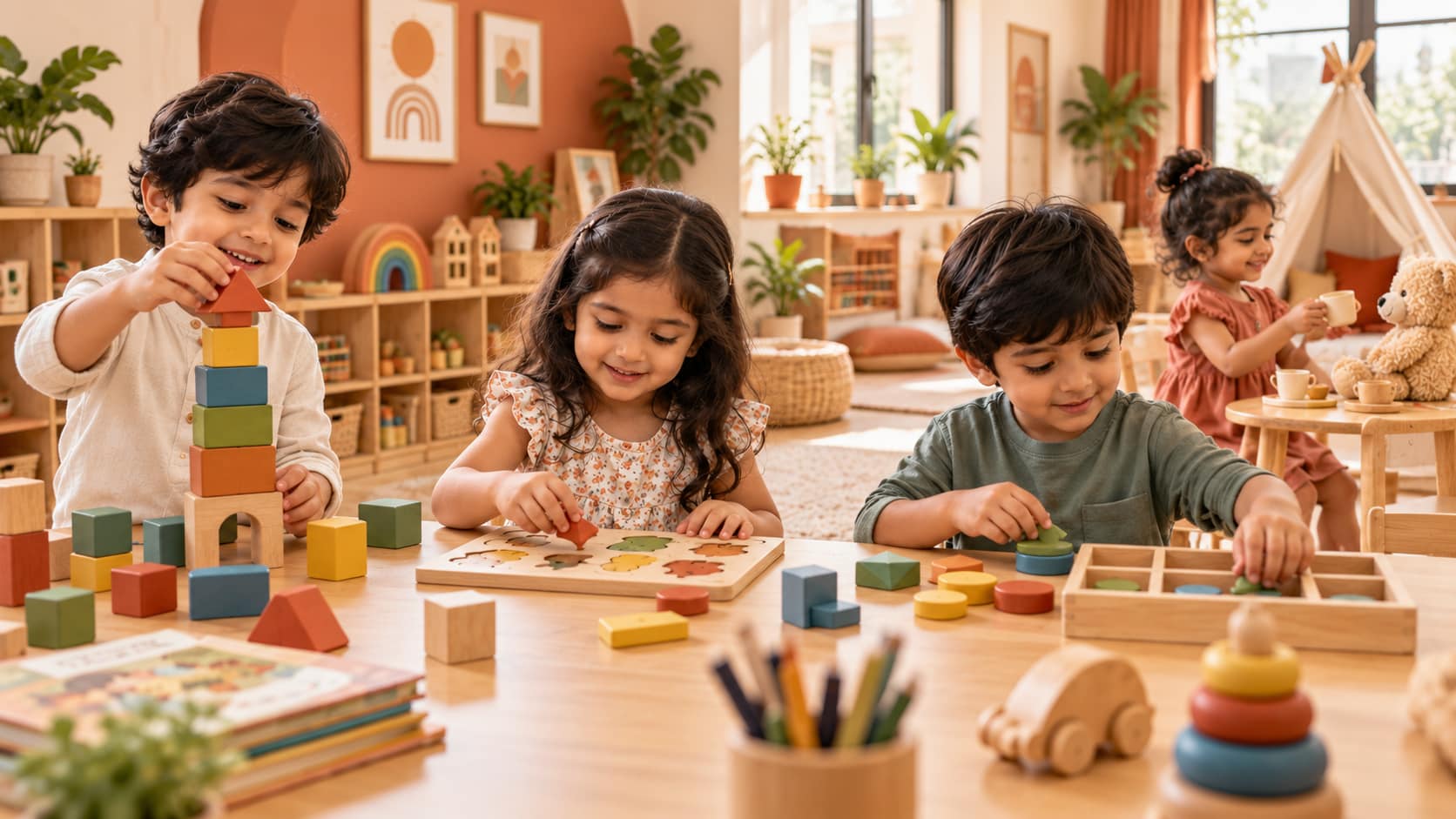
When preschoolers play, they are doing much more than having fun. Building a tower, pretending to run a shop, completing a puzzle or experimenting with water all require children to think, make choices and solve small problems. These everyday experiences help develop the skills they will use for learning later. Understanding the connection between play and cognitive development can also help parents make better choices about activities at home and what to look for in a preschool. Here is how meaningful play supports thinking, learning and problem-solving and why play should be an important part of early childhood.
What Is Cognitive Development in Preschoolers?
Cognitive development refers to how children learn to think, understand, remember, reason, solve problems and make sense of the world around them.
During the preschool years, children are developing rapidly. They begin asking more questions, making connections between ideas, remembering increasingly complex information and finding different ways to solve problems.
Cognitive development is not limited to knowing letters or numbers. It also includes skills such as attention, memory, language, reasoning, decision-making, curiosity and flexible thinking.
This is one reason play matters so much. According to the National Association for the Education of Young Children (NAEYC), play supports cognitive skills such as remembering, problem-solving, decision-making, information processing and language development.
Why Is Play Important for Preschoolers?
Play gives children a reason to think.
When a child tries to build a tower that keeps falling, for example, they are not simply moving blocks around. They may be experimenting with balance, size, position and cause and effect. When the tower falls, they have an opportunity to change their approach and try again.
This kind of hands-on experience makes learning active rather than passive.
NAEYC describes play as an important part of children’s learning and development, supporting cognitive, language, social and self-regulation skills.
India’s National Curriculum Framework for the Foundational Stage also places play at the centre of early learning. It describes free, guided and structured play as different ways children can learn and recommends balanced opportunities for play throughout the foundational stage.
The point is not that children should play instead of learning. For young children, well-designed play is one of the ways learning happens.
How Play Supports Cognitive Development in Preschoolers
1. Play develops problem-solving skills
Preschoolers encounter small problems constantly during play.
A puzzle piece does not fit. A block tower falls. A toy needs to be repaired. Two children want the same material. A pretend shop needs more food.
Each situation encourages the child to think: What can I do differently?
Instead of immediately providing the answer, adults can give children time to experiment.
Try asking:
“Why do you think it fell?”
“What could we change?”
“Which piece might fit here?”
“What could we try next?”
These questions encourage children to think through a problem instead of simply waiting for an adult to solve it.
2. Play strengthens attention and memory
Many games require children to remember information and stay focused.
A simple matching game requires children to remember where cards are located. Simon Says requires them to listen carefully and remember a rule. Following a recipe during pretend cooking requires them to remember a sequence.
These may look like simple games, but they involve mental processes that support learning.
Harvard University’s Center on the Developing Child includes play among experiences that can support developing executive-function skills, including attention and self-regulation.
3. Pretend play encourages imagination and flexible thinking
Pretend play gives children opportunities to represent one thing as another.
A cardboard box can become a bus. A chair can become a shop counter. A child can pretend to be a doctor, teacher, chef or parent.
This requires symbolic thinking and the ability to use objects, words and ideas to represent something else.
Pretend play also encourages children to consider different perspectives. When children act out a story together, they have to remember their role, respond to others and adapt when the story changes.
That makes pretend play valuable for both cognitive and language development. Parents can explore the benefits of pretend play for preschoolers to discover more ways imaginative play can support thinking, communication and creativity.
4. Play builds early mathematical thinking
Children do not need worksheets to begin developing mathematical ideas.
They encounter numbers, shapes, patterns, measurement and comparison naturally during play.
Building blocks can introduce concepts such as:
- Bigger and smaller
- Taller and shorter
- More and less
- Balance
- Shape
- Position
- Counting
Pretend shopping can introduce counting and simple quantities. Sorting buttons or toys by colour and size helps children notice patterns and categories.
NAEYC specifically highlights how play materials and activities can support children’s early mathematical thinking, including number, measurement and problem-solving.
5. Play supports language and thinking
Language and cognitive development are closely connected.
During play, children describe what they are doing, ask questions, explain ideas, negotiate roles and create stories. These conversations help them organise their thoughts and communicate what they understand.
For example, a child playing with toy animals might say:
“This one is hiding because it is scary.”
That simple sentence contains imagination, emotion, cause and effect, and language development.
Parents can extend this learning by asking open-ended questions rather than turning play into a quiz.
Instead of asking only, “What colour is this?” try:
“Where do you think the animal is going?”
“What might happen next?”
“Why did you put that there?”
Cognitive Development Activities for Preschoolers
The best activities do not need to be complicated or expensive. Everyday materials can provide excellent opportunities for thinking and exploration, and these preschool activities at home offer simple ways for parents to encourage curiosity and learning through play.
Puzzles and matching games
Puzzles encourage children to recognise shapes, remember information, compare pieces and persist when something does not work.
Start with puzzles appropriate to your child’s developmental level. The goal is to challenge without frustration.
Building and construction
Blocks, magnetic tiles and other construction materials encourage children to plan, test ideas and understand relationships between objects.
Ask children what they are building and what they think might make the structure stronger. Let them discover the answer rather than correcting every attempt.
Sorting activities
Give children everyday objects such as spoons, bottle caps, toy animals or coloured blocks and ask them to sort them.
There does not have to be only one correct method.
Children might sort objects by colour, size, shape or function. Then ask them to explain their reasoning
Storytelling and story sequencing
Read a familiar story and ask your child what happened first, next and last.
You can also give them pictures and let them create their own story.
This supports memory, sequencing, language and imagination.
Simple science experiments
Water play is an easy way to introduce prediction and observation.
Ask:
“Which object do you think will float?”
“What happened when we added more water?”
“What do you think will happen if we try this?”
The objective is not to teach a formal science lesson. It is to encourage curiosity and reasoning.
Outdoor exploration
Outdoor play provides opportunities for observation, movement and discovery.
Children can look for different leaves, compare stones, observe insects, follow simple directions or notice changes in weather and nature.
The National Curriculum Framework for the Foundational Stage emphasises learning through children’s senses and whole-body engagement in playful activities. Parents can also explore the importance of outdoor play in Montessori education to understand how outdoor experiences can encourage observation, movement and discovery.
What Is Play-Based Learning?
Play-based learning is sometimes misunderstood as giving children toys and leaving them completely on their own.
In a quality early-learning environment, play can be child-led, guided by an educator or structured around a particular learning objective.
NCERT’s National Curriculum Framework for the Foundational Stage describes free play, guided play and structured play as different points on this continuum. In guided play, for example, children retain an active role while teachers support exploration and ask questions that extend learning.
This balance matters.
Children need opportunities to choose, explore and experiment, but skilled adults can also introduce materials, ask thoughtful questions and help children make connections.
The result is learning that feels meaningful rather than forced.
How Parents Can Encourage Cognitive Development Through Play
You do not need to turn your home into a classroom.
In fact, constantly directing children’s play can sometimes take away the opportunity for them to make their own decisions.
Instead, create an environment where children have safe opportunities to explore.
Keep some simple materials accessible, such as blocks, books, puzzles, drawing materials, pretend-play objects and household items that can be used safely for imaginative play.
Then give your child time.
If a tower falls, resist the urge to rebuild it immediately. If your child asks a question, explore the answer together. If they create an unusual story, ask them to tell you more.
NAEYC recommends play experiences that engage children deeply enough to encourage curiosity, problem-solving, focused attention and persistence.
Sometimes the most valuable thing a parent can do is simply stay interested without taking over.
What Should Parents Look for in a Preschool?
If cognitive development is important to you, look beyond worksheets and visible academic activities when visiting a preschool.
Ask what children actually do during the day.
Do they have opportunities to build, explore, talk, imagine, experiment and solve problems? Are teachers asking open-ended questions? Can children work independently? Are learning materials accessible? Is there a healthy balance between guided activities and child-led exploration?
A strong preschool environment should give children meaningful opportunities to think and discover while providing appropriate adult guidance. It should also allow children enough time to explore activities without unnecessary pressure, an approach discussed further in Montessori learning at their own pace.
This is also consistent with India’s foundational-stage framework, which describes teachers as creating stimulating, engaging environments that emphasise play and discovery.
For a Montessori environment, parents can additionally ask how hands-on materials, independence and purposeful activities are incorporated into the child’s everyday experience.
What Parents Should Avoid
More activities do not automatically mean more learning.
A child’s day does not need to be filled with worksheets, classes and adult-directed tasks from morning to evening.
Avoid turning every play activity into a test.
If your child is drawing, you do not always need to ask them to name every colour. If they are building, you do not need to correct every structure. If they are pretending, you do not need to control the storyline.
Children also need time to explore ideas in their own way.
The adult’s role is to provide a safe environment, observe, participate when appropriate and extend the child’s thinking without taking control.
Conclusion
Cognitive development in preschoolers does not happen only during formal lessons. It happens when children build, imagine, compare, question, remember, experiment and try again.
That is why play deserves a meaningful place in early childhood. A puzzle can develop persistence. Blocks can encourage planning. Pretend play can strengthen language and imagination. Outdoor exploration can spark curiosity about the world.
For parents, the goal is not to make every moment educational. It is to give children rich opportunities to explore and think and to choose preschool environments where play and learning naturally work together. This approach can also support confidence and independence, as explained in how Montessori builds confidence and independence.
At Cherubs Montessori, parents can explore the learning environment and understand how Montessori education approaches early childhood development before making an admission decision. A campus visit is the best way to see how children learn and interact for themselves.
Frequently Asked Questions
Why is play important for cognitive development?
Play gives children opportunities to remember, experiment, make decisions, solve problems, communicate and adapt their thinking. These experiences help develop cognitive skills while keeping children actively engaged.
What are good cognitive development activities for preschoolers?
Puzzles, building blocks, sorting games, storytelling, pretend play, simple science experiments, matching games and outdoor exploration can all encourage cognitive development.
Does play-based learning prepare children for school?
Yes. Well-designed play can support foundational skills such as language, attention, problem-solving, memory, self-regulation and early mathematical thinking. India’s National Curriculum Framework specifically incorporates play-based learning into the foundational stage.
Is pretend play good for cognitive development?
Yes. Pretend play encourages imagination, symbolic thinking, language, memory and flexible thinking. Children also practise planning and adapting when they create and change imaginary situations.
How can parents support cognitive development at home?
Provide opportunities for children to explore, build, read, draw, pretend and solve age-appropriate problems. Ask open-ended questions and give them time to work things out independently instead of immediately providing answers.