

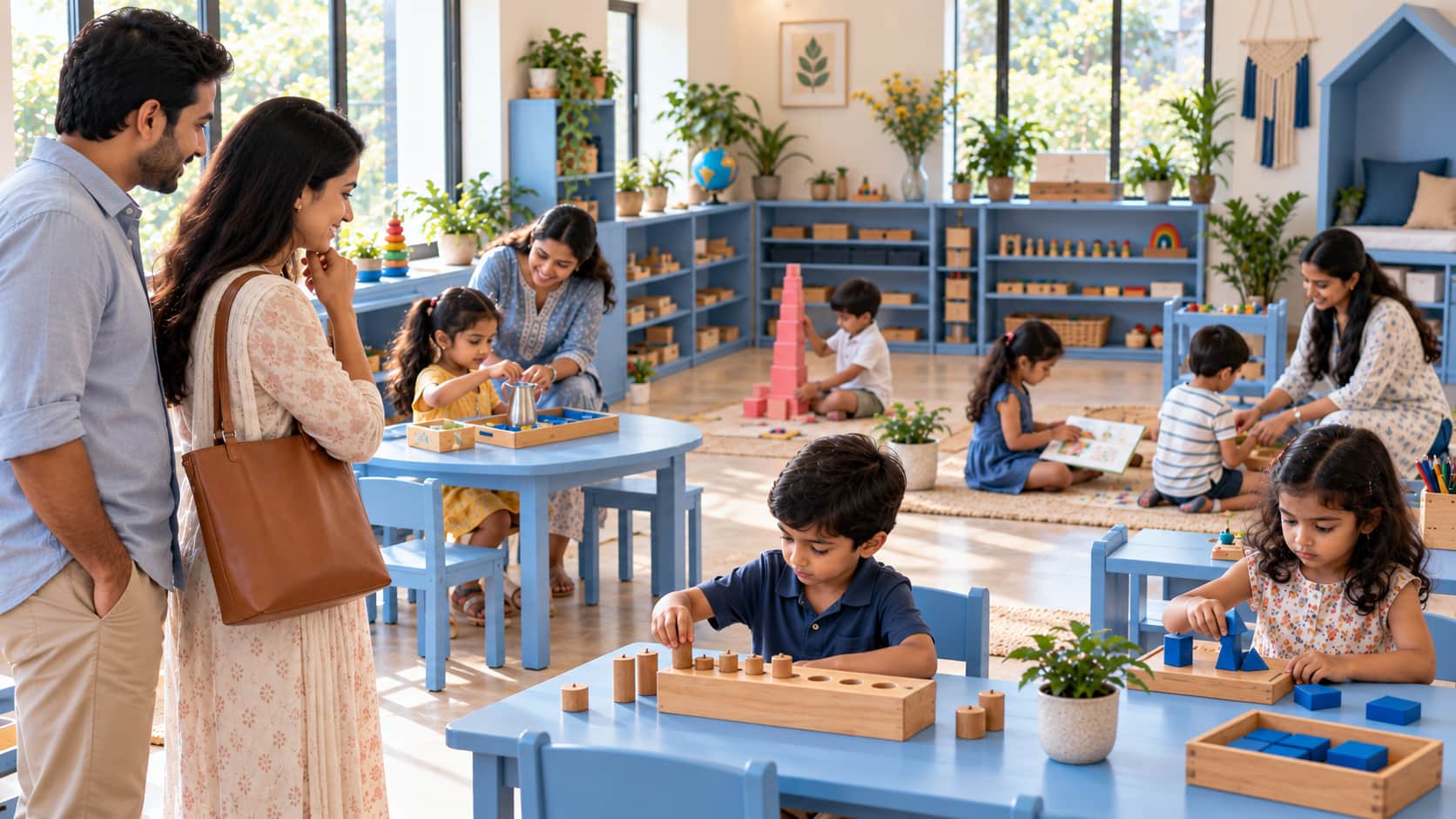
Choosing a preschool is rarely just about finding a school nearby. Parents are comparing teaching approaches, teachers, safety, routines, fees, transport, and most importantly whether their child will feel comfortable there. The difficult part is that brochures and school websites can make very different preschools sound almost identical. So how do you know what actually matters? This guide will help you look beyond attractive facilities and marketing language. You’ll learn what to ask during a preschool visit, what to observe for yourself, and how to decide which preschool is genuinely the right fit for your child and family.
How to Choose a Preschool: Start With Your Child
Before comparing preschools, think about your child.
A preschool that works well for one child may not be the best fit for another. Some children are eager to join groups and explore independently, while others need more time to settle, prefer predictable routines, or need extra encouragement before participating.
Ask yourself: What kind of environment will help my child feel secure, confident and ready to learn?
Consider your child’s independence, communication, temperament, interests, comfort around other children and ability to manage simple routines. You do not need to label your child. The goal is simply to understand what you should look for during a preschool visit.
India’s National Curriculum Framework for the Foundational Stage recognises that children develop at different rates and places play at the centre of learning during the foundational years. That means the right preschool is not necessarily the one with the longest list of facilities. It is the one that provides an environment where your child can develop comfortably and meaningfully.
10 Questions to Ask When Choosing a Preschool
A school visit becomes much more useful when you arrive with specific questions. Instead of collecting simple “yes” answers, ask the school to explain how things work.
1. What educational approach do you follow?
Ask the preschool to explain its teaching approach in simple terms.
A school may describe itself as Montessori, play-based, activity-based or use another educational model. The label is only the starting point. What matters is what children actually experience each day.
Ask how new concepts are introduced, how much time children have for independent exploration, how play is incorporated, and how language, early mathematics, movement and practical skills are developed.
If you are considering Montessori, ask how Montessori principles are implemented in the classroom rather than simply whether the school uses the word “Montessori.”
Cherubs Montessori describes its programmes as age-specific Montessori environments for children from 18 months to 6 years, with programmes designed around independence, language, early literacy, numeracy and school readiness.
2. Who will be teaching my child?
Teachers have a major influence on a child’s everyday preschool experience.
Ask about teacher qualifications, Montessori or early-childhood training, professional development and staff continuity. One useful question parents sometimes overlook is:
“How long do teachers typically stay at the preschool?”
During your visit, watch how teachers speak to children. Do they listen patiently? Encourage independence? Respond calmly when a child refuses an activity?
These everyday interactions can tell you more than a statement about “experienced educators.”
3. What is the teacher-to-child ratio?e
Ask for the actual classroom arrangement rather than a general claim about small classes.
Find out how many children are in your child’s group, how many adults are regularly present, whether numbers change during meals or outdoor play, and who supervises children when a regular teacher is absent.
A smaller group does not automatically guarantee quality, but appropriate staffing can make it easier for educators to notice and respond to individual children.
4. What does a normal day look like?
This is one of the most useful questions you can ask.
Rather than accepting phrases such as “holistic development,” ask the school to describe an ordinary day from arrival to departure.
Understand the balance between teacher-guided activities, independent work, play, movement, outdoor activity, practical routines, creative experiences and social interaction.
A particularly useful question is:
“What would my child actually be doing at 10 a.m. on an ordinary Tuesday?”
A concrete answer gives you a much better picture of the preschool than a list of programme names.
5. How do you help children settle into preschool?
Starting preschool can be a significant transition. Children differ in how quickly they become comfortable, so ask how the school handles separation anxiety and the settling-in period.
Find out what happens if a child remains distressed, how teachers build familiarity and trust, and how parents are updated when adjustment takes longer than expected.
A child crying during the first few days does not automatically mean the preschool is unsuitable. What matters is how adults respond.
You can also read more about child adjustment to preschool in India to understand this transition in greater detail.
6. How do you handle behaviour and emotions?
Preschoolers are still learning how to express frustration, wait for their turn, communicate their needs and resolve conflicts.
Ask what happens when a child has a tantrum, refuses an activity, pushes another child, becomes withdrawn or repeatedly struggles with a routine.
Listen for calm guidance, consistent boundaries and age-appropriate strategies. You are not looking for a classroom where children never have difficult emotions. You are looking for adults who know how to respond to those emotions respectfully.
7. How do you track my child's development?
Ask how educators observe and document development and how this information is shared with parents.
The conversation should go beyond letters and numbers. Ask how the preschool looks at language and communication, social interaction, independence, motor development, concentration, problem-solving and emotional development.
A good preschool should recognise that children develop at different rates rather than expecting every child to progress identically.
8. What exactly does “safe” mean here?
“Is the preschool safe?” is too easy to answer.
Instead, ask about the systems behind the claim. How is entry controlled? How are authorised pickups verified? Who supervises outdoor activities? What happens during a medical emergency? How are classrooms and play areas maintained? How are parents contacted during an emergency?
Then look around yourself.
Are children properly supervised? Are classrooms and bathrooms clean? Are gates and access points appropriately managed? Do staff appear attentive?
Cherubs Montessori publishes safety provisions including CCTV monitoring, secure infrastructure, emergency and medical support, and GPS-enabled transport. Parents should still ask how these systems operate in practice.
9. What is the complete cost?
Do not compare preschools using tuition alone.
Ask what is included and whether there are additional charges for admission, registration, transport, meals, uniforms, learning materials or activities.
The most useful question is:
“What will I actually pay from admission through the end of the academic year?”
Ask for the fee structure in writing so you can make a fair comparison.
10. How does the school communicate with parents?
Your relationship with the preschool continues after admission.
Ask how parents receive updates about their child’s development, how concerns are raised, who to contact when an issue occurs, and how parent-teacher meetings are handled.
Good communication is particularly valuable during the settling-in period, when parents naturally want useful feedback about how their child is adjusting.
What to Observe During a Preschool Visit
Questions tell you what a preschool says about itself. Observation tells you something else.
Watch the children first. Do they appear comfortable and engaged? Can they explore appropriately? Do teachers notice when a child needs help? Are children encouraged to try things independently?
Then watch the adults.
A teacher calmly helping a child through a difficult moment can reveal more about the school’s culture than an impressive activity room.
During your visit, pay attention to:
- Teacher-child interactions
- Classroom organisation and cleanliness
- Age-appropriate learning materials
- Transitions between activities
- Toilets, eating areas and play spaces
- Opportunities for movement and exploration
- How staff respond when children become upset
You can also explore the Cherubs Montessori gallery before visiting, but photographs should complement not replace a campus visit.
What Matters Most When Choosing a Preschool?
Parents often wonder whether teachers, curriculum, facilities or safety should be the deciding factor.
In reality, these areas work together.
A strong curriculum will not achieve much without capable, attentive educators. Excellent teachers also need a safe and well-managed environment.
A practical way to compare preschools is to consider five areas:
| Factors | What to look for |
|---|---|
| Teachers | Warm, attentive and appropriately trained educators |
| Learning approach | A clear philosophy visible in daily practice |
| Child experience | Play, exploration, interaction and independence |
| Safety and care | Supervision, hygiene and clear procedures |
| Family fit | Location, timings, transport, fees and communication |
The “best preschool” is therefore not necessarily the one with the biggest campus or most impressive brochure. It is the one that fits your child’s needs and your family’s practical reality.
How to Compare Preschools Without Getting Overwhelmed
After visiting several schools, details can start blending together.
One school may have better facilities, another may have warmer classroom interactions, while another may have more convenient timings.
Create a simple comparison after each visit. Rate each preschool from 1 to 5 for teacher interaction, learning approach, child comfort, safety, daily routine, individual attention, parent communication, location and overall fit.
Do not automatically choose the school with the highest score. Use the comparison to identify what matters most to your family.
If a school has excellent facilities but your child appears uncomfortable and you could not get clear answers about teacher interaction, those concerns should not be ignored.
What Parents Often Overlook
The commute
A preschool that looks perfect during a weekend visit may feel very different when your child has to travel there every weekday.
Consider the actual morning and afternoon journey. In Bengaluru, traffic and pickup arrangements can become part of your child’s daily routine.
What happens during difficult moments
A preschool tour naturally shows the school at its best. Try to notice what happens when a child cries, refuses an activity or needs help.
You are not looking for perfect silence. You are looking for adults who respond calmly and respectfully.
What happens after admission
Ask who parents contact when they have a concern, how issues are handled and how developmental updates are shared.
This can reveal how seriously the preschool treats the parent-school relationship after admission.
Whether Montessori is really Montessori
If you are considering a Montessori preschool, ask to see the learning environment and understand how Montessori materials and principles are used.
Cherubs Montessori describes its approach as authentic Montessori education and offers programmes for children from 18 months to 6 years. The most useful next step is to ask the school what that approach looks like during an ordinary classroom day.
Red Flags to Watch For
No preschool will be perfect, but certain patterns deserve attention.
Be cautious if staff cannot clearly explain the educational approach, safety procedures or fee structure. Take note if teacher-child interactions consistently appear impatient or dismissive, or if marketing claims are impressive but staff cannot explain how those promises translate into daily practice.
Also be wary of a preschool that focuses almost entirely on academic performance for very young children or discourages parents from asking reasonable questions.
The goal is not perfection. A school that openly explains its policies and limitations can be more reassuring than one that claims everything is flawless.
Montessori or Traditional Preschool: Which Is Better?
There is no universal answer.
Montessori education places strong emphasis on independence, hands-on learning, purposeful activity and structured environments that allow children to work with appropriate materials. Other preschool approaches may place greater emphasis on teacher-led activities, guided play or different forms of curriculum organisation.
The better question is:
“Which approach fits my child and my family’s expectations, and is it implemented well here?”
If you are comparing approaches, explore this Montessori vs. traditional preschool comparison and learn more about choosing the right Montessori school in Bangalore.
The quality of implementation matters more than the label.
A Simple Final Test Before You Choose
Before making your decision, ask yourself four questions:
Can I explain how my child will spend a normal day here?
Do I trust the adults who will be with my child every day?
Does the school’s approach match what I want for my child’s early years?
Can our family realistically manage this preschool every day?
If you can answer all four confidently, you are probably looking at the decision from the right perspective.
Why a Campus Visit Matters
Online research can help you create a shortlist, but choosing a preschool is ultimately a decision about an environment your child will experience in person.
At Cherubs Montessori, the published admission process includes an enquiry and campus visit, followed by child interaction, registration and confirmation. Visiting allows parents to see the environment and understand the Montessori approach before making a decision.
If Cherubs Montessori is on your shortlist, you can explore the admission process and arrange a visit.
The purpose of a preschool visit is not to prove that a school is perfect. It is to decide whether it is the right fit for your child.
Conclusion
Choosing a preschool becomes easier when you stop looking for the school that simply sounds “best” and start looking for the one that fits your child and family.
Ask specific questions, observe the classroom, pay attention to teacher-child interactions and understand how learning, safety, behaviour guidance and parent communication work in practice. Do not make the decision from a brochure alone.
A thoughtful preschool choice is one where you can picture your child feeling safe, respected, curious and increasingly independent and where you feel confident in the adults supporting them.
If you are considering Cherubs Montessori, the next step is to explore the admission process and arrange a campus visit.
Frequently Asked Questions
What is the most important thing to consider when choosing a preschool?
Look at the quality of your child’s everyday experience: teachers, learning approach, safety, emotional environment and opportunities for development. Location, timings and fees also matter because the preschool needs to work for the entire family.
How do I know if a preschool is good?
Visit the campus, observe teacher-child interactions, ask about the daily routine and understand how the school handles safety, behaviour and children’s developmental needs.
What questions should I ask when choosing a preschool?
Ask about the educational approach, teachers, teacher-to-child ratio, daily routine, settling-in process, behaviour guidance, developmental tracking, safety, complete fees and parent communication.
Should I choose Montessori or a traditional preschool?
Neither is automatically better for every child. Compare how each approach is implemented and whether it matches your child’s needs and your family’s expectations.
How many preschools should I visit?
There is no fixed number. A small shortlist of schools that meet your location, schedule and educational requirements is usually enough to make a meaningful comparison.
What should I observe during a preschool visit?
Pay attention to teacher-child interactions, classroom organisation, cleanliness, supervision, learning materials, transitions, children’s comfort and how staff respond when a child needs help.