

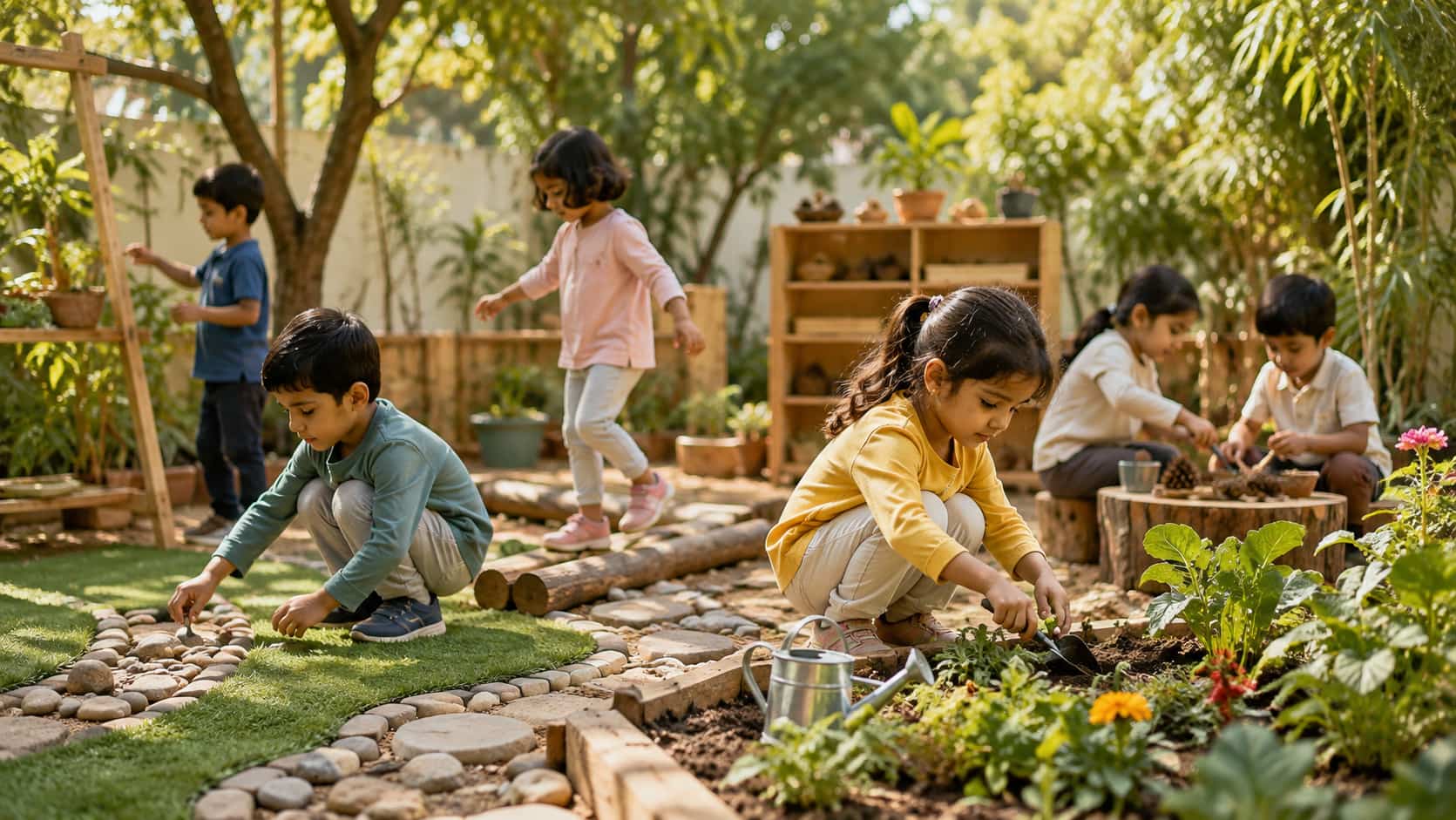
Outdoor play is often seen as a break from classroom learning, but in Montessori education, the outdoors can be part of the learning environment itself. A child running, balancing, gardening, observing an insect, or negotiating a game with friends is developing more than physical strength. These experiences can support independence, concentration, problem-solving, communication, and a connection with nature. For parents considering Montessori preschool, understanding the importance of outdoor play in Montessori education can offer a clearer picture of how learning happens beyond classroom walls. This article explores the developmental benefits of outdoor play and what parents should look for in a Montessori environment.
What Is Outdoor Play in Montessori Education?
In Montessori education, outdoor play is not simply a scheduled period when children leave the classroom to release energy. It can be an extension of the prepared environment, giving children opportunities to move freely, explore real surroundings, make choices, and interact with nature.
The Montessori Foundation describes outdoor environments as an important part of Montessori practice, with activities such as gardening, caring for plants, observing birds, and exploring natural materials connecting directly with practical life, science, and sensory learning.
This distinction matters. A child watering plants is not only exercising their arms. They are learning to handle a real object carefully, control their movements, notice what a living thing needs, and complete a purposeful task. Similarly, observing ants, leaves, clouds, soil, or flowers can turn an ordinary outdoor experience into an opportunity for scientific observation.
The goal is not to make every outdoor moment into a formal lesson. Montessori works particularly well when children have freedom within appropriate limits to explore, repeat activities, and discover things at their own pace.
Why Is Outdoor Play Important in Montessori?
The importance of outdoor play in Montessori education comes from the close relationship between movement, independence, sensory experience, and real-world learning.
Young children learn through their bodies as well as through language and materials. Outdoor environments provide space for large movements that may be difficult to accommodate indoors. Running, climbing, jumping, carrying, balancing, digging, and walking over different surfaces give children varied opportunities to refine coordination and body control.
Montessori education also places considerable value on direct contact with the natural world. The Association Montessori Internationale explains that Montessori viewed outdoor environments as an extension of the classroom, where children can observe natural processes and develop curiosity, patience, and an understanding of interconnectedness.
So, outdoor learning is not an addition to Montessori philosophy. When thoughtfully planned, it reinforces several principles that already exist inside the Montessori environment.
6 Benefits of Outdoor Play for Preschoolers
The benefits of outdoor play for preschoolers extend across several areas of development. What looks like simple play may involve several developmental processes happening at the same time.
1. Outdoor Play Builds Gross Motor Skills
Outdoor spaces naturally encourage movement. Running, jumping, climbing, balancing and navigating different surfaces challenge children to coordinate their bodies and understand space.
This is particularly valuable during the preschool years, when children are rapidly developing physical abilities. The CDC recommends that children aged 3-5 be physically active throughout the day and encourages caregivers to provide varied opportunities for active play.
A Montessori outdoor environment can make this movement purposeful rather than turning it into repetitive exercise. This also connects with the broader role of physical fitness in preschool, where regular movement can support children’s overall physical development.
2. It Encourages Concentration and Observation
Outdoor environments are full of details that invite children to stop and look closely.
A child might notice that one leaf is larger than another, observe an insect moving across the ground, wonder why a puddle has disappeared, or watch how a plant changes over several days. These moments encourage observation and naturally lead to questions.
This is one reason outdoor learning in Montessori can complement classroom activities. Something encountered outside can become the starting point for vocabulary, classification, art, science, or further investigation indoors.
The outdoor environment therefore does not have to compete with academic learning. It can give children real experiences that make later concepts more meaningful.
3. It Supports Independence and Practical Life
One of the most distinctive aspects of Montessori outdoor play is the opportunity to give children genuine responsibility.
Gardening is an obvious example. A child may help plant seeds, carry water, remove fallen leaves, or observe changes in a growing plant. The activity involves coordination, but it also introduces responsibility and sequence: What needs to happen first? What does the plant need? What should I do next?
The Montessori Foundation highlights gardening, caring for living things, composting, conserving resources, and maintaining outdoor spaces as practical ways children can develop responsibility and care for the environment.
These experiences can be especially powerful because the result is real. A child is not pretending that a plant needs water; the plant actually does. Activities like these also give children opportunities to practise essential life skills for preschoolers, such as responsibility, coordination, following a sequence and caring for their surroundings.
4. Outdoor Play Develops Social and Emotional Skills
Outdoor play creates social situations that children have to navigate themselves.
Children may decide how to use shared equipment, create a game, negotiate rules, take turns, work together, or resolve a disagreement. These interactions can develop communication, cooperation, patience, and problem-solving. Outdoor situations can give children small, real-life problems to work through, which connects naturally with how Montessori encourages problem-solving skills through hands-on experiences.
Outdoor play can also give children room to regulate their energy through movement. Recent research examining preschool educators’ experiences found that teachers, including Montessori teachers, described outdoor play as supporting physical, cognitive, social and emotional development and helping children return indoors calmer or more focused.
That does not mean outdoor play automatically solves behavioural or attention difficulties. Children are different, and development is influenced by many factors. But regular opportunities for movement and child-led exploration can form an important part of a balanced early-learning environment.
5. It Strengthens the Child's Connection With Nature
Children cannot fully understand the natural world through pictures alone.
Seeing a real tree change with the seasons, watching an insect move through soil, feeling different textures, listening to birds, or caring for a living plant gives children direct sensory experiences.
Montessori’s emphasis on nature makes this especially relevant. The Montessori Foundation notes that contact with nature can be integrated with areas such as botany, zoology, geography, practical life and sensory development.
Over time, these experiences can help children develop not just knowledge about nature but an attitude of care toward living things and their surroundings.
6. It Provides Space for Meaningful Movement
Preschool children are not designed to remain physically still for long periods.
The World Health Organization recommends that children aged 3–4 spend at least 180 minutes in physical activity of varying intensity across the day, including at least 60 minutes of moderate-to-vigorous activity.
Outdoor play is one practical way of creating opportunities for that movement. Importantly, the recommendation is about overall physical activity, not a requirement that all activity happen outdoors.
This distinction is useful for parents. A good preschool should not be judged simply by how large its playground is. What matters is whether children receive meaningful opportunities to move, explore and participate in age-appropriate activities throughout the day.
How Does Montessori Use Outdoor Play?
Montessori outdoor play can take many forms depending on the school’s environment, children’s ages, weather and available resources.
A well-prepared outdoor area might include space for physical movement alongside opportunities for gardening, nature observation, sensory exploration, practical-life activities and open-ended play.
The key is that the environment should invite children to participate rather than requiring adults to direct every moment. This approach can also support the same confidence and independence that Montessori education aims to develop through everyday choices and purposeful activities.
For example, a teacher might introduce a child to a gardening activity and demonstrate how to water a plant. The child can then repeat the activity, observe the result and gradually take more responsibility. Another child may become interested in an insect or leaf and receive support in identifying or investigating it.
This approach reflects the Montessori role of the adult as a guide and observer rather than someone who controls every action.
What Makes Outdoor Play Truly Montessori?
Simply having a playground does not automatically make outdoor play Montessori.
Parents evaluating a preschool can look beyond the presence of swings, slides or open space. A more meaningful question is: What opportunities does the outdoor environment give the child to choose, explore, move, contribute and learn?
A Montessori-aligned outdoor environment generally benefits from:
- Opportunities for purposeful movement
- Age-appropriate freedom within clear safety boundaries
- Natural materials and opportunities for sensory exploration
- Practical activities such as gardening or caring for the environment
- Time for child-led exploration
- Opportunities to observe and investigate nature
- Adults who guide and observe rather than unnecessarily interrupting children’s activity
The Montessori National Curriculum Online similarly describes daily outdoor free play as extending children’s opportunities for physical activity and emphasises freedom of movement and activities that help children develop control of their physical movements.
In other words, the quality of the experience matters more than the number of pieces of playground equipment.
Outdoor Play Should Not Mean Unsupervised Play
There is an important balance between freedom and safety.
Montessori encourages independence, but independence does not mean removing appropriate adult supervision. Young children need environments designed around their developmental abilities, with adults who understand when to step back and when to intervene.
The CDC notes that outdoor play in early-care and education settings provides developmental opportunities but also carries risks of injury and illness. It recommends age-appropriate environments, supervision and attention to outdoor safety.
For parents visiting a preschool, this is worth observing directly. Look at whether outdoor spaces are maintained, whether children can move safely, whether adults can see and support them, and whether the activities match the children’s ages and abilities.
The objective is not a risk-free environment. It is a thoughtfully managed environment where children can gradually develop physical confidence and judgement without being exposed to unnecessary hazards.
What Can Parents Look for During a Preschool Visit?
If outdoor learning is important to your family, do not settle for asking, “Does the school have outdoor play?”
Ask what children actually do outdoors.
Observe whether children are given opportunities to move, explore and make choices, or whether outdoor time is mainly limited to free running on playground equipment. Ask how teachers supervise outdoor activities, how nature is incorporated into learning, and whether children participate in practical activities such as gardening or caring for their environment.
It is also useful to ask how the school adapts outdoor activities to weather and local conditions. In Bengaluru, for example, heat, rain and air-quality conditions can affect how outdoor activities are planned. A thoughtful preschool should be able to explain how it balances outdoor opportunities with children’s comfort and safety.
How Outdoor Play Fits Into Cherubs Montessori's Approach
Cherubs Montessori describes physical development as part of its early-learning approach and says children participate in structured play, outdoor activities and interactive games designed to support movement and motor development. Its existing discussion of physical fitness also describes outdoor activity as part of the everyday learning experience rather than a completely separate task.
The school currently serves children from 18 months to 6 years through age-specific Montessori programmes and has campuses including Cherubs Montessori HSR Layout, Sompura and Jayanagar. Its HSR Layout campus information also describes a safe, child-friendly environment and provides an opportunity for parents to visit the campus and understand the Montessori approach in person.
For parents comparing Montessori preschools in Bangalore, a campus visit can therefore be more informative than relying only on a brochure. Watching how children move, interact and explore can reveal how the school’s philosophy translates into everyday experiences.
Simple Montessori Outdoor Activities for Preschoolers
Outdoor learning does not require elaborate equipment. What matters is giving children meaningful opportunities to interact with their environment. Parents can also extend this type of hands-on learning at home through simple preschool activities for learning at home, using everyday materials and age-appropriate tasks.
A child can collect and sort leaves, water plants, observe insects, walk along different surfaces, transfer soil, identify sounds, care for a small garden area, or watch how shadows change during the day. These activities can be adapted to age and ability.
The best Montessori outdoor activities often have another quality: they leave room for repetition. A child may want to water the same plants every morning or repeatedly observe the same patch of soil. Instead of assuming that repetition means boredom, Montessori recognises that repeating purposeful activity can help children refine movement, concentration and understanding.
Conclusion
The importance of outdoor play in Montessori education goes well beyond giving children a chance to burn off energy. When thoughtfully planned, outdoor experiences allow young children to move, observe, make choices, care for living things, solve everyday problems and interact with others. They connect physical development with practical life, sensory learning and curiosity about the natural world. For parents choosing a Montessori preschool, the most useful question is not simply whether children go outside, but what they are able to discover and do when they get there. A campus visit can help you see whether the school’s outdoor environment genuinely supports the independence, movement and holistic development that Montessori education aims to nurture.
Frequently Asked Questions
Why is outdoor play important in Montessori education?
Outdoor play supports Montessori principles by giving children opportunities for movement, independence, sensory exploration, practical work, observation and connection with nature. It can complement indoor Montessori activities rather than functioning only as a break from learning.
How does outdoor play benefit preschool children?
Outdoor play can support physical development, coordination, movement, social interaction, observation, problem-solving and opportunities for independent exploration. Regular physical activity is also recommended for healthy growth and development during the preschool years.
How does Montessori use outdoor play?
Montessori can use outdoor spaces for free movement, nature observation, gardening, practical-life activities, sensory exploration and child-led discovery. The outdoor environment can function as an extension of the prepared environment.
Does Montessori outdoor play have to involve gardening?
No. Gardening is a useful Montessori-aligned activity, but outdoor learning can also involve movement, nature walks, observation, sensory exploration, art, games and practical tasks. The important consideration is whether the activity gives children meaningful opportunities to engage with their environment.
How much outdoor play should preschool children get?
There is no single universal number that represents the ideal amount of outdoor play for every preschool. The WHO recommends at least 180 minutes of physical activity across the day for children aged 3–4, with at least 60 minutes at moderate-to-vigorous intensity. The CDC likewise recommends that preschool-aged children be physically active throughout the day.
What should parents check when choosing a Montessori preschool?
Look at more than the playground. Consider the safety and preparation of the outdoor environment, the variety of activities offered, children’s freedom to explore within appropriate limits, teacher supervision, opportunities for nature-based learning and how outdoor experiences connect with the wider Montessori programme.