

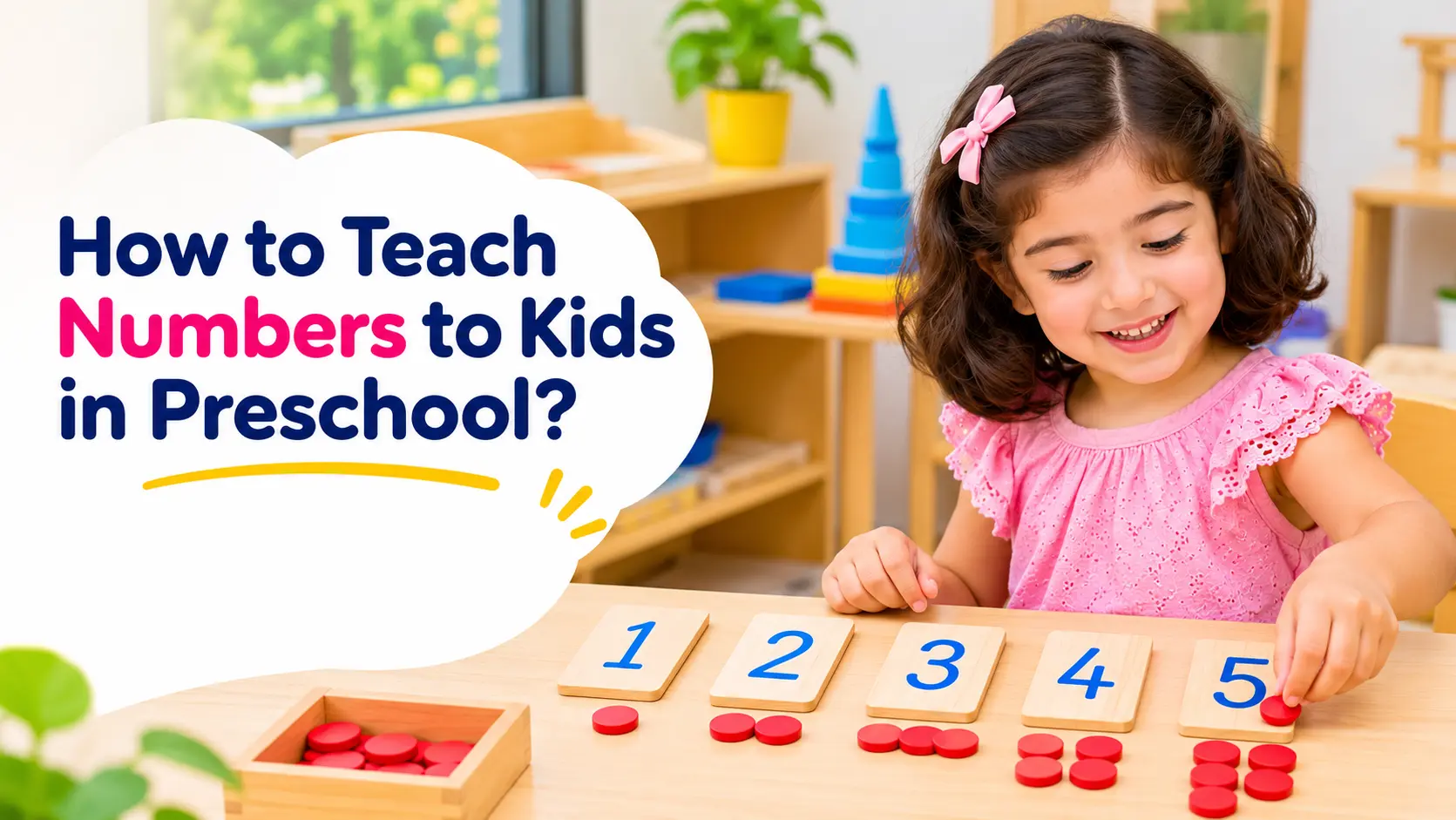
Learning numbers is an exciting part of your child’s preschool journey. However, recognising number symbols and understanding what they represent are two different skills. Simply memorising numbers from 1 to 10 does not always mean a child understands quantities.
Parents can make early mathematics enjoyable through simple counting games, everyday activities and Montessori-inspired learning experiences. With the right approach, children can gradually connect numbers with real objects and familiar situations.
Here are some practical ways to teach numbers to kids in preschool, including activities you can easily try at home.
Key Takeaways
- Children learn about numbers through everyday interactions, counting and play.
- Number recognition and counting are different but connected early mathematics skills.
- Hands-on activities help children connect written numbers with actual quantities.
- Montessori materials such as number rods and sandpaper numerals introduce numbers through physical exploration.
- Parents can practise counting using toys, fruits, blocks and household objects.
- Children develop early number skills at different rates, so learning should remain enjoyable and pressure-free.
Why Is It Important to Teach Numbers in Preschool?
Learning numbers helps children understand quantities, recognise patterns and make sense of their surroundings. Early mathematics also introduces concepts such as more, less, equal and how many.
For example, when a child counts three apples or identifies two shoes, they begin connecting number words with real objects.
Preschool number activities also encourage observation, logical thinking and simple problem-solving. Everyday experiences provide natural opportunities to explore mathematics without making learning feel like a formal lesson.
How Do Preschool Children Learn Numbers?
Children gradually develop number understanding through counting, observing, matching and exploring objects. Parents can introduce these skills through three simple approaches.
1. Start With Counting Everyday Objects
Begin with familiar objects such as toys, fruits, blocks and spoons.
For example, place three building blocks in front of your child and count them together: one, two, three.
Encourage your child to touch or move each object while counting. This introduces one-to-one correspondence, which means matching one number word with one object.
Introduce Number Recognition
After children become familiar with counting, introduce written number symbols using colourful number cards, books and simple tracing activities.
Start with a small selection of numbers rather than showing all ten at once. Ask your child to identify familiar numbers during everyday activities, such as spotting a number on a calendar or lift display.
The goal is to help children understand that a written numeral represents a number.
Practise Counting and Matching
Connect number symbols with actual quantities.
For example:
- Show the number 1 and place one toy beside it.
- Show the number 2 and place two toys beside it.
- Show the number 3 and place three toys beside it.
This helps children understand the relationship between a number’s name, its written symbol and the quantity it represents.
8 Fun Number Activities for Preschool Children
Parents do not need expensive educational toys to introduce early mathematics. Simple household materials can make counting activities interesting and interactive.
1. Number Card Matching
Materials: Number cards and small household objects.
Place number cards from 1 to 5 on a table. Ask your child to place the corresponding number of objects beside each card.
For example, place two buttons beside number 2 and four blocks beside number 4.
Learning focus: Number recognition and quantity matching.
2. Counting Blocks
Materials: Colourful building blocks.
Give your child a small collection of blocks and count them together. Encourage your child to touch each block once while saying the corresponding number.
You can also ask, “Can you give me three blocks?”
Learning focus: Counting and one-to-one correspondence.
3. Montessori Sandpaper Numbers
Materials: Sandpaper number cards or textured numeral cards.
Introduce one number at a time. Demonstrate how to trace the numeral using a finger while saying its name.
Children can explore the shape and direction of the number through touch and observation.
Learning focus: Tactile exploration and number recognition.
4. Number Sorting Game
Materials: Number cards and safe, age-appropriate counting objects.
Place different number cards on a table. Ask your child to create separate groups containing the matching number of objects.
For example, place three large toy blocks beside number 3.
Learning focus: Sorting, counting and quantity association.
5. Counting with Fingers
Materials: No additional materials required.
Use your fingers to demonstrate small quantities. Show one finger, then two, and gradually introduce larger numbers.
Ask your child to copy the finger patterns and count aloud together.
Learning focus: Number representation and counting practice.
6. Number Hunt
Materials: Number cards or familiar objects displaying numbers.
Turn number recognition into a simple treasure hunt. Ask your child to find familiar numbers around the house, such as numbers on a calendar, clock or door.
When your child finds a number, say its name and discuss where it appears.
Learning focus: Recognising numbers in everyday surroundings.
7. Counting Songs and Rhymes
Materials: Counting songs and simple rhymes.
Sing familiar counting songs together, such as “One, Two, Buckle My Shoe” or “Five Little Monkeys”.
Use your fingers to demonstrate the numbers while singing. Repeating songs makes number sequences familiar and enjoyable.
Learning focus: Number sequence and listening skills.
8. Snack-Time Counting
Materials: Suitable food items such as banana slices or other age-appropriate snacks.
During snack time, ask your child to count the pieces on their plate.
For example, ask, “How many banana slices do you have?” Count them together and discuss whether another slice would make the total larger.
Learning focus: Everyday counting and understanding quantities.
Always supervise young children during food-based activities and avoid choking hazards.
How Does the Montessori Method Teach Numbers?
The Montessori approach introduces mathematics through hands-on materials, exploration and meaningful experiences. Instead of relying only on memorisation, children interact with objects that represent mathematical ideas.
Learning Through Hands-On Materials
Some familiar Montessori mathematics materials include:
- Number rods: Red and blue rods that represent quantities from one to ten.
- Sandpaper numerals: Textured number symbols that children explore through touch and tracing.
- Spindle boxes: Materials that help children connect written numerals with counted quantities and explore zero.
- Cards and counters: Materials used to match number symbols with quantities.
Connecting Numbers With Quantities
For example, a child can explore a number rod representing five and compare its length with shorter rods. This creates a physical connection between the number and its quantity.
Learning Through Exploration
Children benefit from opportunities to repeat activities, explore materials and practise at a comfortable pace. Educators can introduce new concepts gradually based on what a child is ready to explore.
How Can Parents Practise Numbers at Home?
Parents can include simple mathematics in everyday routines without setting aside a separate study session.
Try these ideas:
- While walking: Count steps together as you climb stairs.
- During mealtimes: Count fruits, plates or spoons.
- While playing: Count toy cars, blocks or building pieces.
- During shopping: Identify numbers on price labels or shop displays.
- While reading: Explore counting books and point to the objects on each page.
These small activities help children notice numbers in familiar situations. The Institute of Education Sciences’ family mathematics guide also provides practical ideas for introducing mathematics through everyday routines and play.
Common Mistakes to Avoid When Teaching Numbers
Parents can make number learning more enjoyable by avoiding a few common mistakes.
- Relying only on memorisation: Encourage children to count and understand quantities instead of only reciting numbers.
- Using only worksheets: Include physical objects, games and everyday activities.
- Introducing too many numbers at once: Start with manageable quantities and gradually introduce more.
- Expecting every child to learn at the same pace: Give children time to explore and practise.
- Making mistakes stressful: Encourage attempts and gently demonstrate the correct approach.
Remember that understanding numbers is a gradual process. Repeating an enjoyable activity is perfectly fine.
How Does a Montessori Preschool Support Early Number Learning?
A Montessori preschool can provide children with opportunities to explore mathematics through prepared learning materials, guided activities and everyday experiences.
At Cherubs Montessori, parents can explore the school’s Montessori learning environment and learn more about its approach to early childhood education.
Families can also explore the HSR Layout campus and Sompura campus to understand the available learning environments and programmes.
Conclusion
Teaching numbers to preschool children does not have to involve complicated lessons or expensive materials. Everyday counting, playful activities and hands-on Montessori experiences can help children become familiar with numbers and quantities.
If you are exploring a Montessori learning environment for your child, discover Cherubs Montessori, explore its admission process or contact the school to learn more about its programmes.
Frequently Asked Questions
At what age should children start learning numbers?
Children can begin noticing number words and quantities during toddlerhood. Parents can introduce simple counting through toys, songs and everyday activities. More structured number activities can be introduced gradually according to the child’s interest and readiness.
How do I teach numbers 1 to 10 to preschoolers?
Start with familiar objects and simple counting activities. Introduce number cards, match each number with the correct quantity and practise through songs, games and everyday experiences.
How can I help my child recognise numbers?
Use number cards, tracing activities, matching games and number hunts. Introduce a manageable number of symbols and revisit them through different activities.
What are the best counting activities for preschoolers?
Counting blocks, sorting objects, finger counting, number matching, counting songs and snack-time activities are simple options for preschool children.
How does Montessori teach numbers?
Montessori mathematics uses concrete materials such as number rods, sandpaper numerals and spindle boxes to help children explore number symbols and quantities through hands-on learning.
Can children learn numbers without worksheets?
Yes. Children can explore numbers by counting toys, arranging fruits, building with blocks, singing number rhymes and playing matching games.